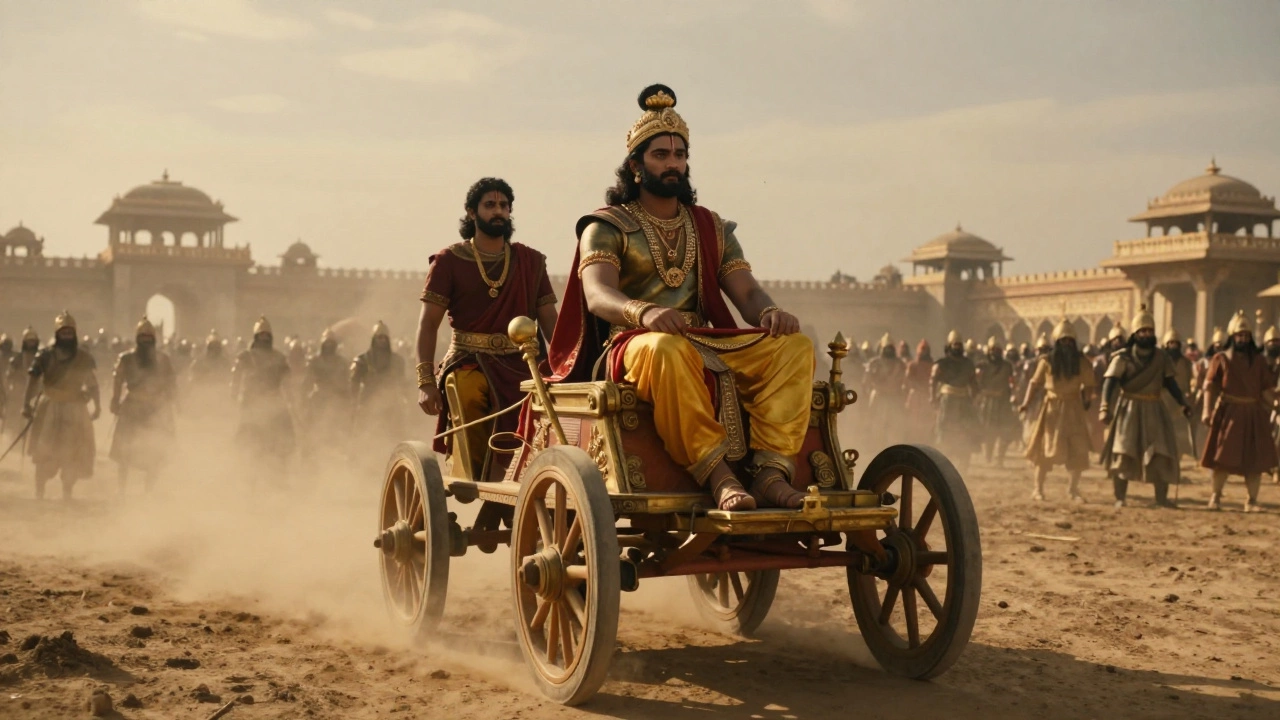
Gita Wisdom Guide: Find Your Anchor
How to use: Select the situation that best describes your current state of mind, and discover which core teaching from the Bhagavad Gita can help you navigate it.
What are you feeling?
Select a scenario on the left to see the guiding principle.
The Path of Karma Yoga
"Karmanye vadhikaraste ma phaleshu kadachana"
The Concept of Dharma
Your "right path" is specific to your own nature, not someone else's blueprint.
The Battle of the Mind
The mind can be your best friend or your worst enemy.
The Eternal Soul
The soul cannot be cut by weapons, burned by fire, or dried by wind.
The Art of Surrender
Letting go of the heavy suitcase of control.
The Gold Standard: Action Without Attachment
If you ask a thousand people for the most famous line, most will point to Chapter 2, Verse 47. It’s the heart of famous Gita quotes and the foundation of what we now call Karma Yoga.The verse says: "Karmanye vadhikaraste ma phaleshu kadachana". In plain English, it means you have a right to perform your prescribed duty, but you are not entitled to the fruits of your actions.
Think about how this applies to a modern job. Imagine you spend three months working on a project. If your entire happiness depends on getting a promotion (the fruit), you'll be a nervous wreck the whole time. But if you focus entirely on the quality of the work itself (the action), you actually perform better. This isn't about being passive; it's about shifting your focus from the trophy to the training. When you stop obsessing over the result, the anxiety disappears, and you find a strange kind of freedom in the work itself.
The Truth About the Soul and Change
Another line that resonates globally is about the permanence of the soul. When Arjuna was terrified of losing his loved ones in the war, Krishna stepped in to explain the nature of existence. He told him that the soul cannot be cut by weapons, burned by fire, or dried by wind.This part of the Bhagavad Gita teaches us that we are more than our bodies or our current circumstances. In a world where we often tie our identity to our age, our looks, or our bank balance, this perspective is a reminder that our core essence is unchanging. It's a powerful tool for dealing with grief or the fear of aging. If the soul is eternal, then the losses we experience in the physical world are just transitions, not ends.
Choosing Duty Over Desire
Many people struggle with the concept of Dharma. Dharma is the cosmic order or individual duty that sustains the universe and ensures moral righteousness.Krishna emphasizes that it is better to perform your own duty imperfectly than to master someone else's duty perfectly. Why does this matter today? We live in an era of constant comparison. We see someone on social media succeeding in a career we don't actually enjoy, and we feel pressure to mimic them. The Gita argues that true fulfillment comes from aligning your actions with your own nature, not by copying a blueprint that belongs to someone else. Your "right path" is specific to you, your skills, and your situation.
| Concept | Key Philosophy | Modern Application |
|---|---|---|
| Karma Yoga | Action without attachment to results | Reducing burnout and performance anxiety |
| Dharma | Following one's inherent nature/duty | Finding a career path based on authenticity |
| Jnana Yoga | The path of knowledge and wisdom | Using critical thinking to overcome ignorance |
| Bhakti Yoga | Devotion and surrender to the Divine | Developing emotional resilience through faith |

The Battle of the Mind
One of the most striking lines in the text describes the mind as a double-edged sword. It says that for those who have conquered the mind, it is the best of friends; but for those who have failed to do so, the mind is the worst of enemies.Have you ever had a day where your own thoughts kept you awake at 3 AM, replaying a mistake from five years ago? That's the mind acting as an enemy. The Gita doesn't tell you to kill your emotions or stop thinking. Instead, it teaches the art of observation. By practicing mindfulness and detachment, you stop being a slave to your impulses. You move from being the person who is swept away by the storm to the person who observes the storm from a safe distance.
Surrender and Peace
As the dialogue reaches its peak, Krishna speaks about the power of total surrender. He tells Arjuna to abandon all varieties of religion and simply surrender to the Divine. To some, this sounds like giving up. But in the context of the Gita, surrender is actually a strategic move.When we try to control every single variable in our lives, we create immense stress. We try to control how people perceive us, how the economy behaves, or how our children turn out. This "control freak" mentality is the root of most of our suffering. Surrendering means acknowledging that there is a larger force-whether you call it God, the Universe, or Nature-that is in charge. It's the mental equivalent of letting go of a heavy suitcase you've been carrying for miles. You aren't stopping your journey; you're just traveling lighter.

How to Use These Lines in Your Daily Life
Reading these verses is one thing; living them is another. If you're feeling stuck, try these three practical shifts based on the Gita's wisdom:- The "Process Only" Rule: Whenever you feel anxious about a deadline or a result, tell yourself, "The outcome is not my business; the effort is." This instantly lowers your cortisol levels.
- The Authenticity Check: Ask yourself, "Am I doing this because it's my Dharma, or because I'm jealous of someone else's success?" If the answer is jealousy, you're fighting someone else's battle.
- The Observer Mode: When an angry thought hits you, don't say "I am angry." Say "I am observing anger in my mind." This small shift in language creates the distance needed to prevent a reactive mistake.
Which line of the Gita is most helpful for stress?
The verse "Karmanye vadhikaraste ma phaleshu kadachana" is the most helpful. By focusing on the action (the process) rather than the result (the reward or failure), you remove the primary source of stress and anxiety, allowing you to work with a calm and clear mind.
Is the Bhagavad Gita only for Hindus?
No. While it is a central text of Hinduism, its teachings on ethics, mental discipline, and duty are universal. People of all faiths-or no faith-use its psychological insights to navigate grief, conflict, and decision-making.
What does "detachment" actually mean in the Gita?
Detachment doesn't mean you stop caring or become cold. It means you stop letting the result of an action dictate your inner peace. You still work hard and love deeply, but you don't let a failure or a loss destroy your sense of self.
Who is the primary audience of the Gita?
Originally, it is a conversation between Krishna and Arjuna. However, Arjuna represents every human being who is confused, hesitant, or facing a moral dilemma. Therefore, the audience is anyone seeking clarity and purpose in life.
How does the Gita view the concept of the soul?
The Gita views the soul (Atman) as eternal, indestructible, and unchanging. It teaches that while the physical body undergoes birth, growth, and death, the soul simply changes "clothes" (bodies), meaning death is not an end but a transition.