Nazm vs Ghazal: Poetry Form Identifier
Analyze the Poem
Select the characteristics present in the poem you are reading.
Analysis Result
Select the features above and click "Identify Form" to see if the poem is a Nazm or a Ghazal.
Have you ever read a poem that felt like a loose conversation, flowing freely from one thought to the next? Now imagine another poem that feels like a tightly woven tapestry, where every line connects to the last through a hidden thread of sound and meaning. These are the two pillars of modern South Asian poetry: Nazm and Ghazal. While both originate from the rich soil of Urdu literature and share deep cultural roots in India, they operate on completely different rules. Understanding the difference isn't just about academic curiosity; it changes how you read, feel, and appreciate the words on the page.
If you’re new to these forms, the distinction can seem blurry at first. Both use rhyme, both deal with emotion, and both have been masterfully used by legends like Mirza Ghalib and Faiz Ahmed Faiz. But the structure is where they diverge sharply. One is a disciplined architectural feat; the other is an expressive, unbound stream of consciousness. Let’s break down exactly what sets them apart.
The Structural Backbone: Radif and Qafiya
The most immediate technical difference lies in the rhyme scheme. In a Ghazal, the structure is rigid. Every couplet (called a misra) must end with the same word or phrase, known as the Radif. Before the Radif, there is a rhyming word called the Qafiya. This creates a repetitive, musical anchor throughout the poem.
For example, if your Radif is "jaata hoon" (I am going), every single line must end with "jaata hoon," preceded by a rhyming word like "aata hoon," "laata hoon," or "jaagta hoon." This repetition creates a hypnotic rhythm. It forces the poet to be incredibly clever, finding new ways to say similar things while adhering to strict sonic constraints.
In contrast, Nazm does not require this repetition. Nazm allows for free verse or varied rhyme schemes. The poet might rhyme every other line, or no lines at all. The focus shifts from the *sound* of the ending to the *meaning* of the progression. You don’t hear the same echo at the end of every stanza. Instead, you follow a narrative arc that moves forward without returning to the same sonic point.
Unity of Theme vs. Independence of Couplets
This structural difference leads to a major shift in how themes are handled. A Ghazal is essentially a collection of independent thoughts. Each couplet stands alone. You could take any two lines from a Ghazal, swap their order, or even remove half of them, and the remaining lines would still make sense individually. They are united only by the rhyme and the general mood-often love, loss, or mysticism-but they do not tell a single continuous story.
Nazm, however, demands unity. It is a cohesive whole. If you remove a stanza from a Nazm, the poem often falls apart because the narrative or argument relies on the sequence. Nazm is used to tell stories, describe social issues, paint landscapes, or argue philosophical points. It has a beginning, a middle, and an end. Think of a Ghazal as a playlist of songs that fit a vibe, and a Nazm as a concept album where every track contributes to a larger message.
| Feature | Ghazal | Nazm |
|---|---|---|
| Rhyme Scheme | Strict (Radif + Qafiya) | Flexible or Free Verse |
| Couplet Independence | Each couplet is self-contained | All stanzas connect to a central theme |
| Primary Focus | Mood, emotion, and musicality | Narrative, imagery, and message |
| Opening Line | Matla (sets the rhyme pattern) | No specific opening requirement |
| Closing Line | Maqta (often includes poet's signature) | Natural conclusion to the narrative |
The Role of Imagery and Metaphor
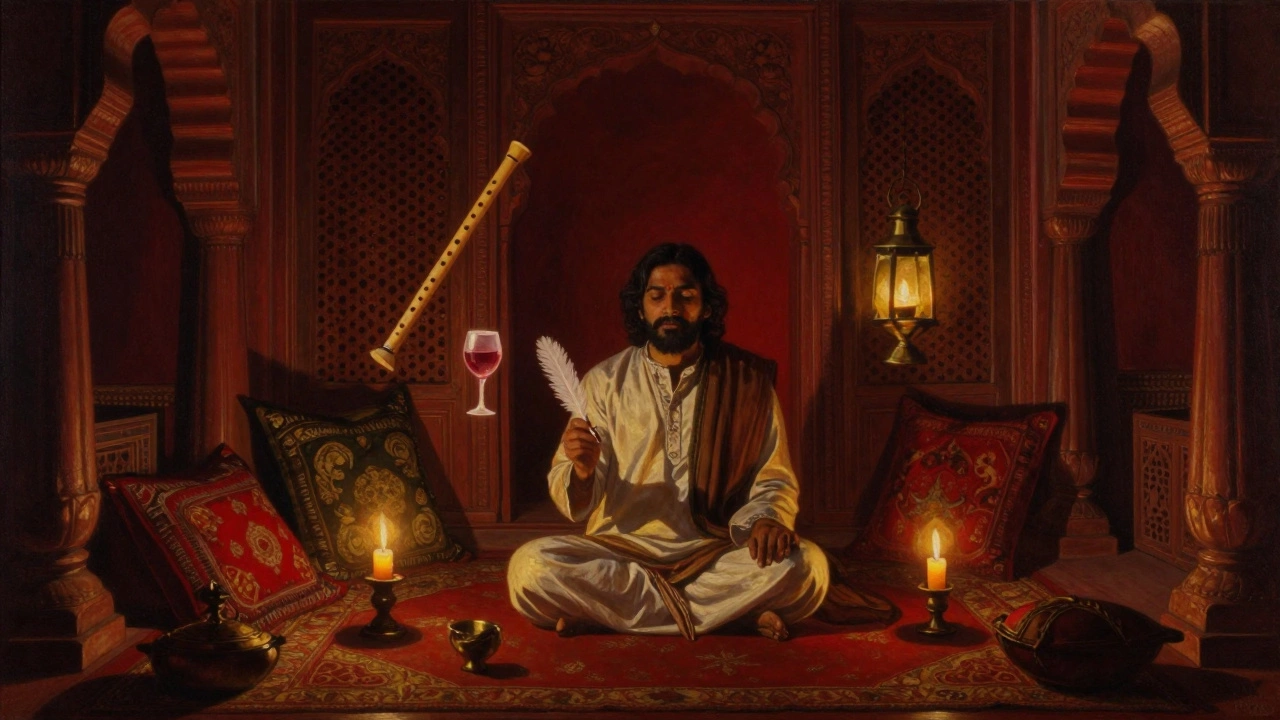
Because the Ghazal is constrained by rhyme, its power comes from metaphor and ambiguity. Poets use symbols like the beloved (Maashooq), wine (Sharaab), and taverns (Maidan) to express complex spiritual or emotional states. The meaning is often layered and open to interpretation. A Ghazal invites you to linger on a single image, turning it over in your mind like a gemstone.
Nazm, being less constrained, tends to be more direct and descriptive. It uses imagery to build scenes rather than just evoke moods. If a Ghazal might whisper about the pain of separation through the metaphor of a broken reed flute, a Nazm might describe the actual streets of a city, the faces of people, and the political climate causing that separation. Nazm emerged strongly during the Progressive Movement in India, where poets wanted to address real-world issues like poverty, colonialism, and social justice. The form allowed for clarity and direct communication.
Historical Context and Evolution
To understand why these forms exist, we have to look at their history. The Ghazal is ancient, tracing its roots back to Arabic and Persian poetry before flourishing in the courts of Mughal India. It was the poetry of royalty, salons, and intimate gatherings. It valued elegance, subtlety, and musical performance. Many Ghazals were written specifically to be sung, which explains their rhythmic precision.
Nazm, as a distinct form separate from traditional structured poetry, gained prominence in the early 20th century. As education spread and new literary movements arose, poets began to reject the strictures of classical forms. They wanted to write about the common man, nature, and national identity. Figures like Allama Iqbal and later Faiz Ahmed Faiz used Nazm to bridge the gap between high art and public discourse. It became the voice of the revolution and the everyday experience.

How to Identify Which Is Which
If you pick up a book of Urdu or Hindi poetry, how do you know which is which? Look at the endings. If every line ends with the same word or phrase, you are likely reading a Ghazal. Check if each couplet makes sense on its own. If yes, it’s a Ghazal. If the poem flows continuously, building an argument or scene from start to finish with varying line lengths and rhymes, it is a Nazm.
Another clue is the tone. Ghazals often feel personal, introspective, and timeless. They deal with universal emotions of love and loss. Nazms often feel contemporary, specific, and grounded. They might reference specific places, historical events, or social conditions. However, modern poets often blend these forms, creating hybrid styles that borrow the musicality of the Ghazal with the narrative freedom of the Nazm.
Why the Difference Matters Today
In today’s world, where attention spans are short and digital media dominates, both forms find new life. Ghazals remain popular in music and cinema because their repetitive structure lends itself well to songwriting. The hook of a Ghazal is instantly recognizable. Nazm, meanwhile, thrives in spoken word performances and social commentary. Its flexibility allows poets to adapt quickly to current events, making it a powerful tool for activism and expression.
Understanding the difference helps you engage deeper with the art. When you read a Ghazal, you aren’t looking for a plot; you are looking for resonance. When you read a Nazm, you are looking for insight. Both offer unique windows into the human experience, but they open those windows in very different ways.
Can a poem be both Nazm and Ghazal?
Strictly speaking, no. A Ghazal requires a specific rhyme scheme (Radif/Qafiya) and independent couplets. A Nazm is defined by its thematic unity and flexible structure. However, modern poets sometimes create hybrid forms that use the musicality of a Ghazal within a longer, narrative-driven Nazm structure, but purists classify them separately based on their dominant features.
Which form is easier to write for beginners?
Nazm is generally considered easier for beginners because it does not require mastering complex rhyme schemes or maintaining independent couplets. You can focus on expressing your ideas clearly and developing a narrative flow. Writing a good Ghazal is notoriously difficult because it requires balancing strict sonic constraints with meaningful content in every single line.
What is the Matla in a Ghazal?
The Matla is the opening couplet of a Ghazal. It is unique because it establishes the rhyme scheme for the entire poem. Both lines of the Matla must contain the Radif and Qafiya, setting the pattern that all subsequent couplets must follow.
Is Nazm always free verse?
Not necessarily. While Nazm allows for free verse, it can also have rhyme schemes. The key difference is that the rhyme scheme in Nazm does not have to be repetitive across every line like in a Ghazal. It can vary stanza by stanza, or follow a simple AABB or ABAB pattern, as long as the thematic unity remains intact.
Who are some famous poets known for Nazm?
Faiz Ahmed Faiz is perhaps the most famous exponent of Nazm, using it to express political and social ideals. Other notable poets include Allama Iqbal, who blended philosophical depth with accessible language, and Amir Khusrau, who experimented with various forms including early iterations of Nazm-like structures.