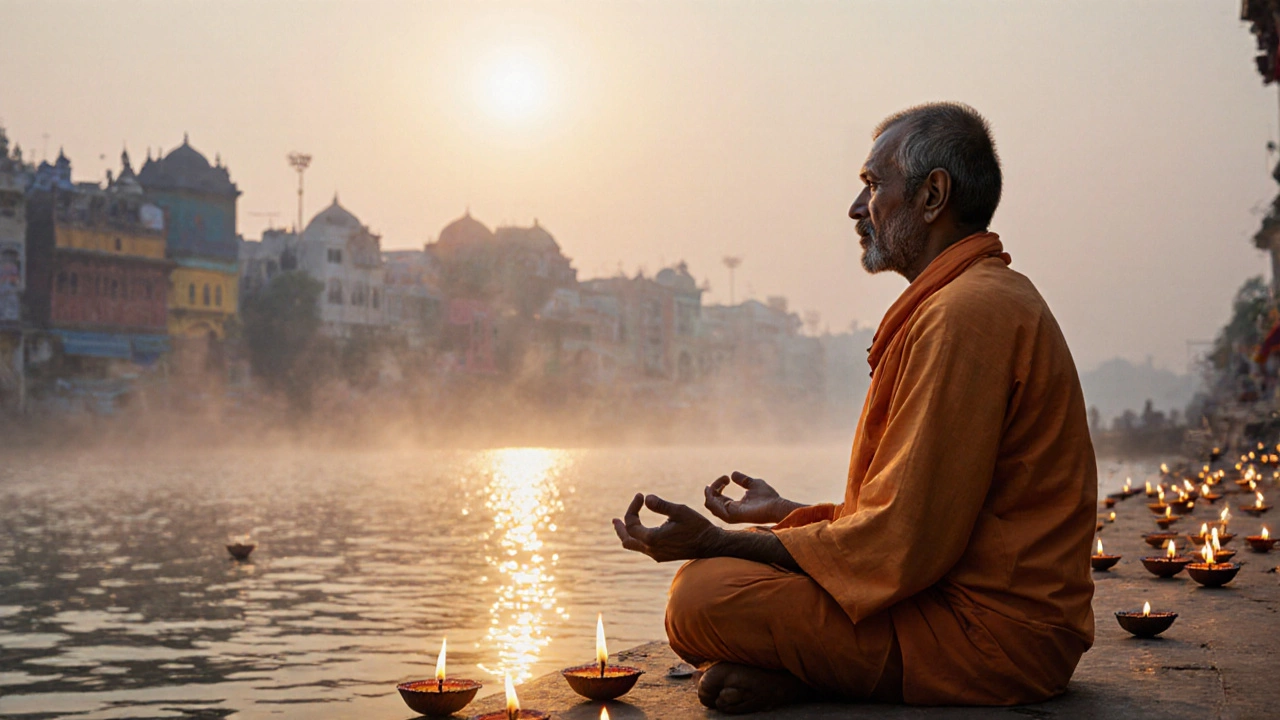
Divine Unity: The Soul of India's Spiritual Heritage
When you hear divine unity, the belief that all life is connected by a single, sacred source. Also known as oneness, it’s not just a philosophy—it’s the heartbeat of how millions in India live, breathe, and see the world. This isn’t abstract mysticism. It’s in the way a mother feeds a stranger’s child, how a temple priest chants for all beings, and why a farmer in Rajasthan bows to the sun before starting his day. You won’t find it in grand temples alone—it lives in the silence between breaths, in the shared roti at a village meal, in the way a Sikh man covers his head not just out of faith, but out of respect for the same divine spark in everyone.
Divine unity doesn’t demand you renounce the world. It asks you to see it clearly. That’s why ancient texts like the Upanishads say "Tat Tvam Asi"—you are that. It’s why the Bhagavad Gita teaches duty without attachment. And it’s why even a poet like Tagore could write about the divine in a child’s laugh or a monsoon wind. This idea connects directly to Indian spirituality, a lived experience rooted in daily rituals, not dogma. It’s why someone in Varanasi chants mantras at dawn, while another in Sikkim rings a bell in a monastery—both are honoring the same invisible thread. Spiritual quotes India, short, powerful lines that carry centuries of wisdom aren’t just Instagram captions. They’re survival tools. In a land of chaos, noise, and deep inequality, these quotes remind people: you are not alone. The divine isn’t far away—it’s in the hand that holds yours.
What makes this different from other spiritual ideas? It doesn’t ask you to choose one god, one path, one truth. It holds space for all of them. A Hindu sees God in the cow, a Muslim in the call to prayer, a Christian in the silence of a church. And still, they all bow to the same sky. That’s unity in diversity, the quiet power that holds India together despite its endless differences. It’s why a single quote from Gandhi can move a factory worker in Mumbai and a monk in Ladakh. It’s why a poem about loss by Neruda finds resonance in a Tamil village. Divine unity isn’t about sameness—it’s about belonging, even when you’re different.
You’ll find this thread running through every post here—not as a slogan, but as a living truth. From the quiet strength of resilience in daily life to the sacred geometry of a temple’s arch, from the wisdom of yogis to the tears in sad poetry, it’s all tied together. No post here tries to explain divine unity with theory. They show it—in the way people eat, pray, grieve, and love. What you’ll read isn’t a lecture. It’s a mirror.