Ask someone what Tamil beliefs are, and you might hear about temple bells, rice offerings, or the sound of conch shells at dawn. But behind these visible rituals lies a deep, layered system of values, cosmology, and daily practices that have shaped life in Tamil Nadu and beyond for over two thousand years. These aren’t just old customs-they’re living beliefs that guide how people wake up, eat, marry, mourn, and make sense of suffering.
Roots in Ancient Traditions
Tamil beliefs didn’t start with Hinduism, even though most Tamils today identify as Hindu. Long before the arrival of Vedic texts, the people of the Tamil region followed a distinct spiritual path tied to nature, ancestors, and local deities. The Sangam literature from 300 BCE to 300 CE describes worship of Murugan as a forest god, Kottravai as a war goddess, and Villi as a hunter deity. These weren’t abstract gods-they were forces tied to specific places: hills, rivers, groves, and villages.
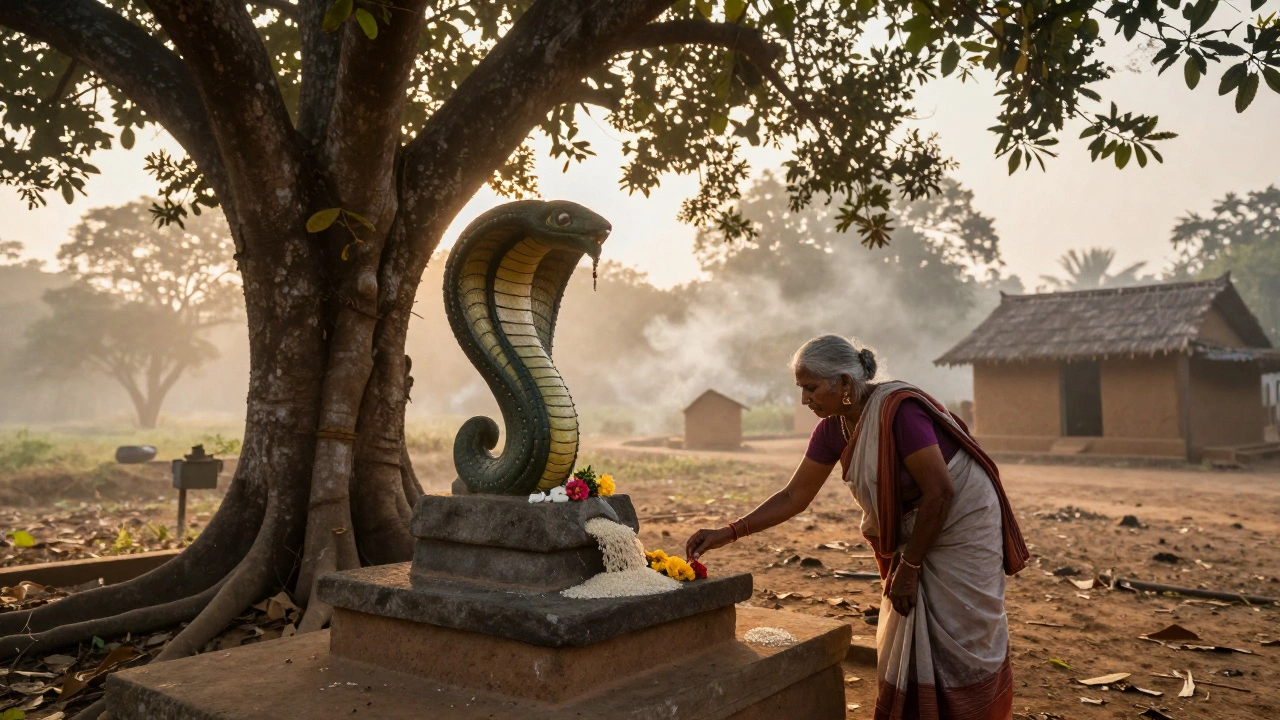
Even today, many rural households have a small shrine outside their door for Naaga (serpent deities), believed to protect the home and ensure fertility. You’ll see stone idols or painted symbols near wells or under trees-not because they’re ‘primitive,’ but because they represent a direct, unmediated connection to the land. This is not folklore. It’s a surviving spiritual system that predates organized religion.
The Role of Hinduism and Syncretism
By the 6th century CE, Tamil Nadu became a center of Bhakti movement-devotional worship led by saints like Appar, Sambandar, and Manikkavacakar. Their hymns, still sung in temples today, weren’t just prayers-they were political acts. These poets rejected caste hierarchy and temple control by Brahmins, insisting that devotion mattered more than birth.
Modern Tamil Hinduism is a blend. The same family might visit a Shiva temple on Tuesday, offer flowers to Mariamman (goddess of disease and healing) during a fever outbreak, and light a lamp for their grandmother’s spirit on the anniversary of her death. There’s no contradiction here. The divine isn’t divided into neat boxes. Murugan, the god of youth and war, is also worshipped as a village guardian. The same deity can be both cosmic and personal.
Unlike North Indian traditions, Tamil Hinduism places heavy emphasis on temple rituals performed by non-Brahmin priests. In many villages, temple duties are passed down through generations of non-Brahmin families. This isn’t an exception-it’s the norm. The belief isn’t that only certain people can speak to God. It’s that God speaks through the land, the community, and the lineage.
Death, Ancestors, and the Unseen World
Tamil beliefs about death are unlike anything you’ll find in Western religions. There’s no single afterlife. Instead, ancestors become part of the spiritual fabric of the family. On the 13th day after death, a ritual called perunkal is performed. Rice balls are offered to the departed soul, and a lamp is kept burning all night. Why? Not to send them to heaven-but to help them transition from a restless spirit to a protective ancestor.
Many Tamil households have a small corner where photos of deceased parents or grandparents are placed. These aren’t just memories. They’re treated as living presences. Food is offered to them before meals. During festivals, a seat is left empty for them. If someone falls ill unexpectedly, the first question isn’t ‘What’s the diagnosis?’ but ‘Did we forget to honor someone?’
There’s no heaven or hell in the Abrahamic sense. There’s only balance. If you ignore your ancestors, you invite misfortune. If you honor them, they guide you. This isn’t superstition. It’s a system of moral accountability rooted in relationships-not divine judgment.
Festivals as Living Beliefs
Tamil festivals aren’t performances for tourists. They’re daily spiritual practices made visible.
During Pongal, the four-day harvest festival, families cook rice in clay pots until it overflows-a symbol of abundance. The first bite is offered to the sun, the earth, and the cattle. No one says a prayer. They just do it. The belief is simple: if you don’t thank the sources of life, they’ll stop giving.
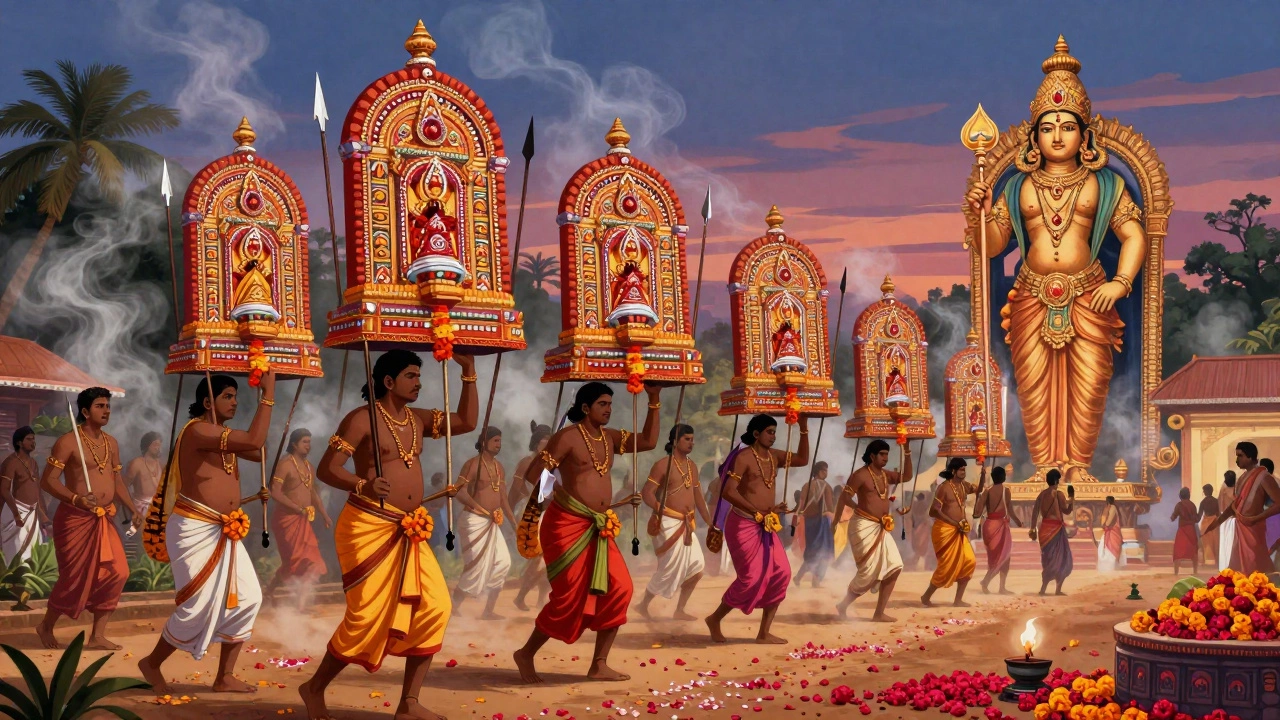
Thaipusam, the festival of Murugan, draws hundreds of thousands. Devotees carry kavadis-ornate frames pierced with hooks and spears-walking barefoot for miles. This isn’t about pain. It’s about surrender. The body becomes a vessel. The belief is that suffering, when offered willingly, cleanses the soul and brings divine favor. A man who carries a kavadi doesn’t say, ‘I’m doing this for God.’ He says, ‘God is doing this through me.’
Even the way food is served reflects belief. Meals are eaten sitting on the floor. Left hand is never used. Food is never wasted. Why? Because everything is sacred. Even a grain of rice has a spirit. To throw it away is to disrespect the earth that gave it.
Everyday Practices as Spiritual Discipline
Tamil beliefs aren’t confined to temples or festivals. They live in routines.
Before stepping out of the house, many Tamils touch the ground and then their forehead. It’s not a ritual for luck. It’s a reminder: you come from the earth, and you return to it. You are not above nature-you’re part of it.
Women often wear a dot (kumkum) on the forehead. It’s not just decoration. It’s a mark of energy-the third eye, the seat of wisdom. In rural areas, men sometimes wear a black thread around the wrist to ward off envy. These aren’t fashion choices. They’re spiritual tools.
Even the way people speak carries belief. It’s common to say, ‘God willing’ (Thiruvaarul) before making plans. Not as a polite phrase, but as a recognition that human control is limited. You plan. But the outcome belongs to something larger.
What Tamil Beliefs Are Not
Tamil beliefs are often misunderstood as ‘superstitious’ or ‘backward.’ But they’re not irrational. They’re relational. They don’t ask you to believe in a distant god. They ask you to honor your home, your ancestors, your food, your neighbors.
They don’t separate the sacred from the secular. There’s no ‘religious’ day and ‘normal’ day. Every act-cooking, cleaning, walking, speaking-is an opportunity to align with the unseen order.
They’re not about guilt or sin. There’s no concept of original sin. Mistakes are corrected through ritual, not punishment. If you break a promise, you don’t ask for forgiveness from God-you make an offering to the local deity. If you hurt someone, you don’t just say sorry-you give food to the poor. Action, not confession, restores balance.
Modern Life and the Persistence of Belief
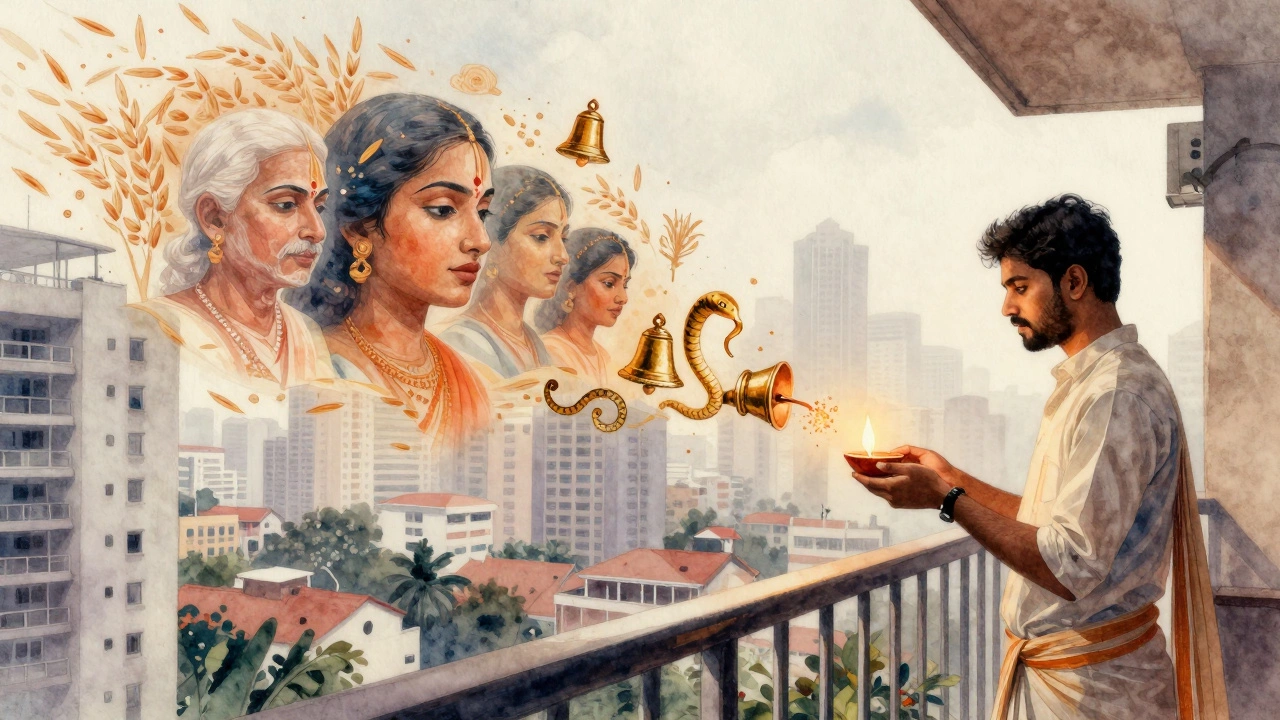
Even in Chennai’s high-rises, you’ll find young professionals lighting a lamp before leaving for work. Students place a small idol of Ganesha on their study table. Migrant workers from Tamil Nadu carry a piece of soil from their village in their luggage. Why? Because belief doesn’t vanish with education or urbanization. It adapts.
A 2023 survey by the Centre for the Study of Social Systems found that 89% of urban Tamils still perform at least one traditional ritual weekly-even if they don’t identify as religious. The belief isn’t about dogma. It’s about continuity. It’s about staying connected to a world that came before you.
Tamil beliefs don’t ask you to convert. They ask you to notice. Notice the wind. Notice the silence before dawn. Notice the person who gave you your first meal. That’s where the divine lives-not in temples alone, but in the rhythm of daily life.
Are Tamil beliefs the same as Hinduism?
Tamil beliefs overlap with Hinduism but are not the same. While many Tamils practice forms of Hindu worship, their traditions include pre-Vedic deities, ancestor rituals, and local customs that predate Sanskrit texts. Tamil spirituality emphasizes community, land, and lineage in ways that differ from mainstream North Indian Hinduism.
Do Tamils believe in reincarnation?
Yes, but not in the abstract way often described in textbooks. Reincarnation is tied to actions and relationships. If you neglect your family, you may return as a restless spirit. If you live with integrity, you become a protective ancestor. The focus isn’t on which body you’ll inhabit next, but on how your actions ripple through generations.
Why do Tamils worship village deities like Mariamman?
Mariamman is worshipped as the protector against disease, drought, and chaos. She represents the raw power of nature-both life-giving and destructive. Unlike distant gods, she’s close. Her temples are in villages, near wells, or at crossroads. People don’t pray to her for salvation-they ask for health, rain, or safety. She’s part of daily survival, not just spiritual theory.
Is ancestor worship still practiced in modern Tamil homes?
Absolutely. In most Tamil households, even in cities, photos of deceased parents are kept on a small shelf. Food is offered to them before meals. On death anniversaries, family members fast or give charity in their name. The belief is simple: ancestors are still part of the family. Ignoring them invites imbalance.
Do Tamils believe in fate or free will?
They believe in both. You make choices-that’s free will. But outcomes depend on your ancestors, your karma, and unseen forces-that’s fate. The key is balance. You do your part, then let go. Saying ‘God willing’ isn’t defeatism. It’s wisdom. You act, but you don’t pretend you control everything.
What Comes Next?
If you want to understand Tamil beliefs, don’t read books first. Go to a village temple at sunrise. Watch how the priest doesn’t chant in Sanskrit but in Tamil. See how the old woman places a banana leaf on the ground before sitting. Notice how no one rushes. There’s no hurry in belief.
Tamil beliefs aren’t about knowing the right answers. They’re about learning how to live with the unknown. They teach patience. They teach gratitude. They teach that the divine isn’t far away-it’s in the steam rising from your rice, in the silence after a prayer, in the hand that passed you your first meal.