Hindi Friendship Quote Translator
Choose a Quote to Explore
Selected Quote
When you think of true friendship, words like loyalty, trust, and silence come to mind. In India, where family bonds run deep and relationships are woven into daily life, friendship isn’t just about hanging out-it’s about showing up, even when no one’s watching. And no one says it better than the old Hindi quotes passed down through generations. These aren’t just pretty phrases. They’re wisdom carved from lived experience.
One Quote That Stands Above the Rest
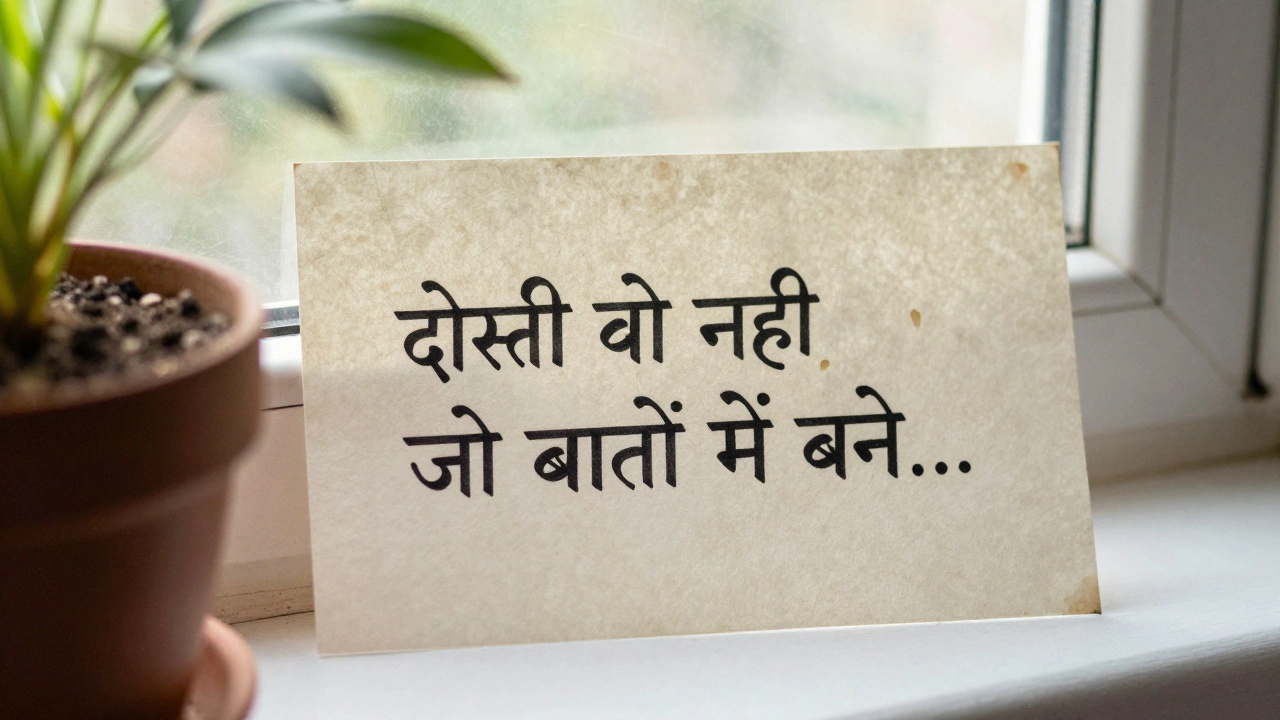
The most powerful Hindi quote about friendship is: "दोस्ती वो नहीं जो बातों में बने, बल्कि वो है जो चुपचाप खड़े रहकर बने" (Dosti woh nahi jo baaton mein bane, balki woh hai jo chupchape khade rehkar bane).
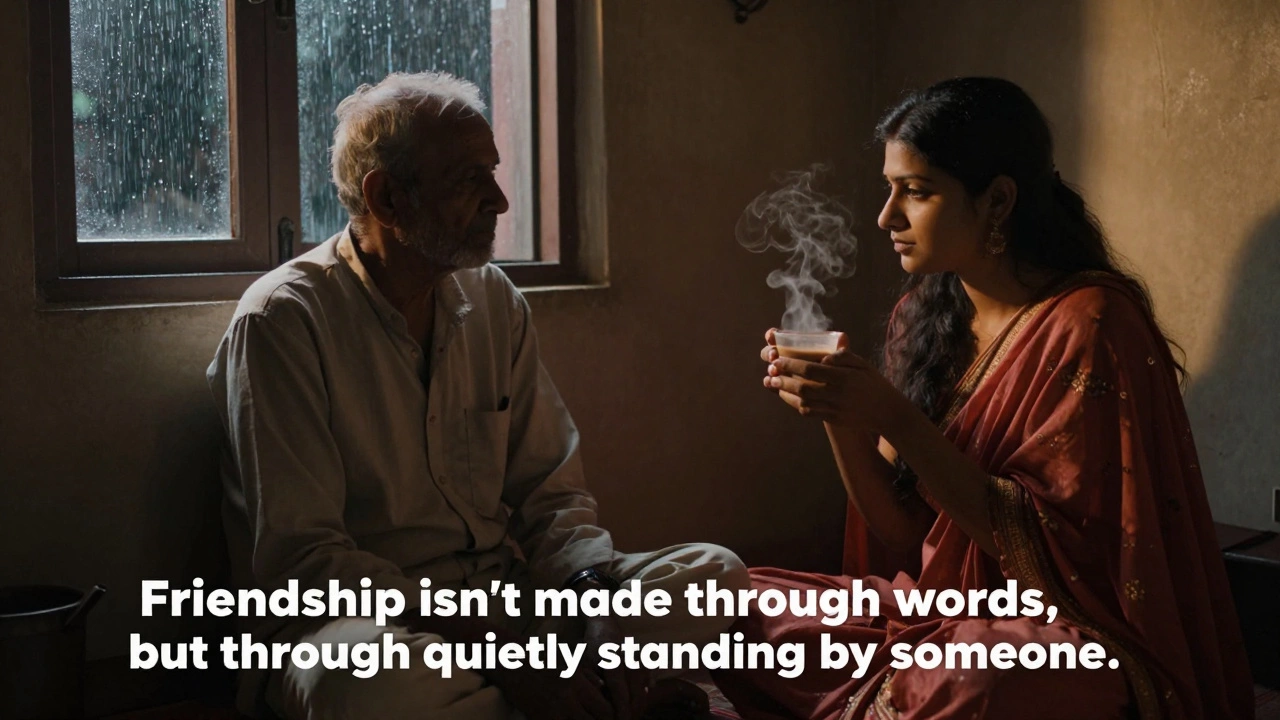
Translated, it means: "Friendship isn’t made through words, but through quietly standing by someone."
This quote doesn’t shout. It doesn’t need fireworks. It speaks to the kind of friend who shows up at your door at 3 a.m. with tea when you’re sick, who doesn’t ask for thanks, and who never texts "How are you?" just to fill silence. They just show up. And that’s the Indian way of saying love.
Why This Quote Resonates Across India
India’s social fabric is built on unspoken understanding. In villages, neighbors share meals without being asked. In cities, old friends remember your mother’s birthday even if you forget. This quote captures that quiet strength. It rejects the modern idea that friendship needs constant updates, likes, or status updates. Real friendship, in this view, is measured in presence, not posts.
Think of a time when you were going through something hard-maybe a job loss, a breakup, or just deep loneliness. Who showed up without a script? Who didn’t try to fix it, but just sat with you? That’s the friendship this quote honors.
Other Powerful Hindi Friendship Quotes
While the first quote stands out, here are three more that carry weight in Indian homes:
- "दोस्त वो होता है जो तुम्हारी गलतियों को भी अपना बना ले" - "A true friend turns even your mistakes into their own." This speaks to unconditional loyalty. It’s not about being perfect-it’s about carrying each other’s burdens.
- "दोस्ती अमूल्य है, लेकिन उसे बनाने के लिए दिल से बात करनी पड़ती है" - "Friendship is priceless, but to build it, you must speak from the heart." This rejects transactional relationships. You can’t buy friendship. You can’t fake it. It needs honesty.
- "जब तक दोस्त हैं, दुनिया तुम्हारी है" - "As long as you have friends, the world is yours." In a country where individual success is often tied to family, this quote reminds us that true wealth is found in connection.

How These Quotes Are Used in Daily Life
In Indian households, these aren’t just quotes you read on a poster. They’re part of everyday speech.
During Diwali, people send cards with these lines scribbled in handwriting. At weddings, the groom’s best man might quote one when giving a toast. When someone moves away, a handwritten note with one of these lines is more meaningful than a thousand WhatsApp messages.
Even in modern cities like Bangalore or Pune, you’ll hear a mother say to her child: "Dosti ka matlab yeh hai-jo tumhare saath khade rahe, chahe tumhari koi baat na ho." (The meaning of friendship is someone who stands with you, even if you say nothing.)
The Cultural Roots of These Sayings
These quotes didn’t come from self-help books. They came from village gatherings, family stories, and the teachings of poets like Kabir and Guru Nanak, who wrote about human bonds long before social media existed.
Kabir once said: "Mitti ki murti, pani ki murti, kisi ko na manta koi" - "A clay idol, a water idol, no one recognizes either." He meant that external things-status, wealth, even words-fade. What lasts is the quiet, steady presence of someone who knows your soul.
That’s why these Hindi quotes still live. They’re not poetic fluff. They’re survival tools. In a society where loneliness is rising, they remind us: connection doesn’t need volume. It needs depth.
Why Western Friendship Models Don’t Always Fit
In the West, friendship is often framed as mutual enjoyment-hanging out, sharing hobbies, texting memes. In India, it’s framed as mutual survival.
Think about it: when you’re in a crisis, who do you call first? In many Western cultures, it’s a partner or therapist. In Indian culture, it’s often a childhood friend. Why? Because those bonds are built on decades of shared history-not just shared playlists.
That’s why the Hindi quote about standing silently by someone hits harder. It doesn’t ask you to talk. It asks you to be there. And that’s a radical act in a world that’s always asking for content.
How to Live This Quote
If you want to live this kind of friendship, here’s how:
- Stop asking "How are you?" just to be polite. If you mean it, show up.
- Remember small things-like how your friend takes their chai, or that they hate Mondays.
- Don’t wait for a reason to call. Just call. Say: "I was thinking of you. No reason. Just wanted to hear your voice."
- When they’re silent, don’t push. Just sit. Silence isn’t empty. Sometimes, it’s the loudest form of love.
- Let go of the need to fix. Sometimes, being present is the only help you can give.
This isn’t about grand gestures. It’s about the tiny, daily acts that say: "I see you. I’m not going anywhere."
Final Thought: Friendship as a Quiet Revolution
In a world that values noise-likes, shares, viral moments-this Hindi quote is a quiet rebellion. It says: real connection doesn’t need an audience. It doesn’t need to be posted. It just needs to be lived.
Maybe that’s why these quotes still echo. Not because they’re old. But because they’re true.
What is the most famous Hindi quote about friendship?
The most famous Hindi quote about friendship is: "दोस्ती वो नहीं जो बातों में बने, बल्कि वो है जो चुपचाप खड़े रहकर बने" - which translates to "Friendship isn’t made through words, but through quietly standing by someone." It captures the essence of loyalty without performance, presence without words.
Are Hindi friendship quotes different from English ones?
Yes. English friendship quotes often focus on fun, laughter, or shared experiences. Hindi quotes focus on endurance, silence, and unspoken support. While Western quotes say "I’ll be there for you," Hindi ones say "I already am." They value action over expression.
Can these quotes be used in modern relationships?
Absolutely. In fact, they’re more relevant now than ever. With rising loneliness and digital noise, the idea of quiet loyalty-showing up without needing to post about it-is a powerful antidote. These quotes remind us that real connection doesn’t need validation. It just needs presence.
Why do Indians value silent friendship?
Indian culture places deep value on duty, sacrifice, and emotional restraint. Expressing feelings openly isn’t always encouraged-especially among men. So, friendship becomes an act of service: helping without being asked, staying without being thanked. Silence isn’t cold; it’s respectful. It’s the language of deep trust.
Where do these Hindi friendship quotes come from?
They’re passed down orally through families, schools, and community gatherings. Many trace their roots to Sufi poetry, Guru Nanak’s teachings, and folk wisdom from rural India. Unlike modern quotes, they weren’t written for social media-they were carved into daily life.