Carnatic Tala Rhythm Explorer
About Adi Tala
The most common talam in Carnatic music. It consists of 8 beats divided into three parts (Avartanam). It is often compared to a 4/4 time signature in Western music but with distinct internal subdivisions.
Hand Gestures (Khallas)
- Downstroke: Strong beat (Samam)
- Upstroke: Weak beat
- Dap: Clapping sound
- Dakshina: Palm turn right
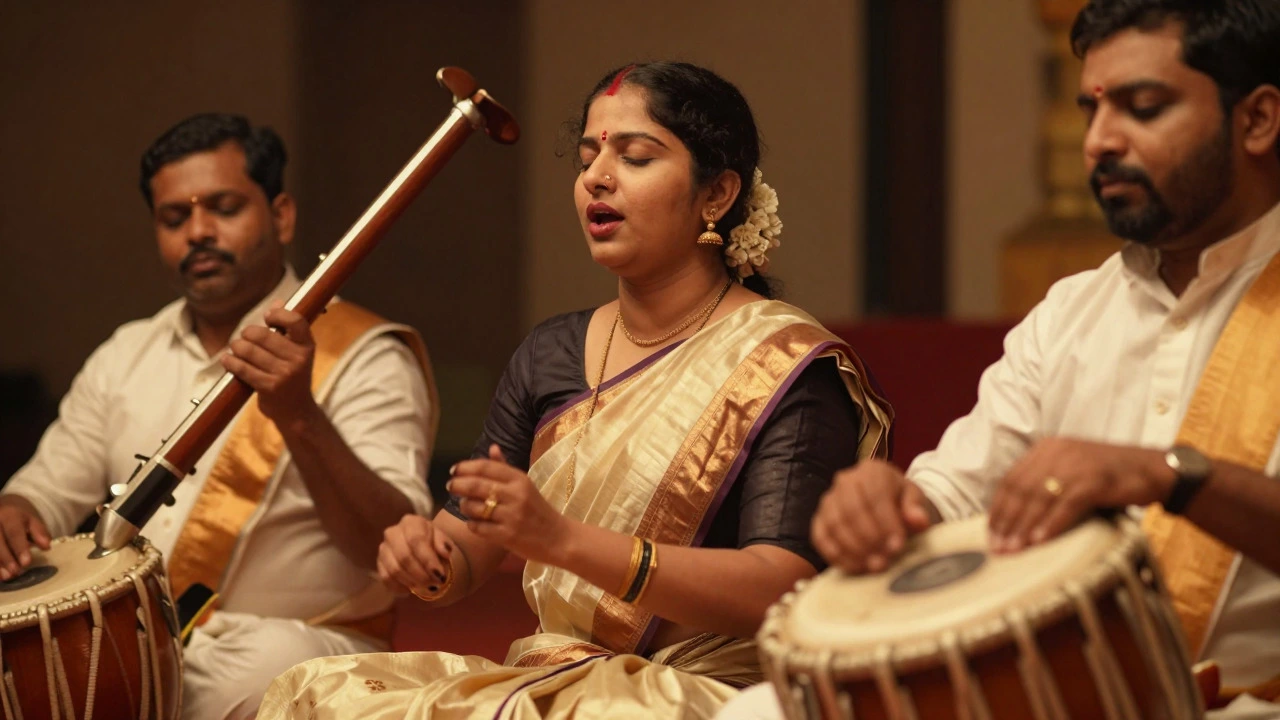
Have you ever heard a voice soar through complex mathematical rhythms while weaving an emotional story that feels centuries old? If you were listening to traditional music from the southern part of India, you were likely hearing Carnatic music, which is the predominant form of classical music in South India, characterized by its intricate melodic structures and rhythmic precision. It is distinct from the North Indian tradition known as Hindustani music. While both share ancient roots, they have evolved into separate systems with unique aesthetics, instruments, and performance practices.
The Origins and Evolution of Carnatic Music
To understand what makes this style special, we need to look back at its history. The foundations of this musical system date back to the Natya Shastra, an ancient Sanskrit text on performing arts written around the 2nd century CE. However, the modern form of Carnatic music largely took shape during the 16th and 17th centuries under the patronage of the Vijayanagara Empire. This period saw the emergence of three legendary composers who are still revered today: Tyagaraja, Muthuswami Dikshitar, and Syama Sastri. Collectively known as the Trinity of Carnatic Music, they composed thousands of songs that remain the core repertoire for performers today.
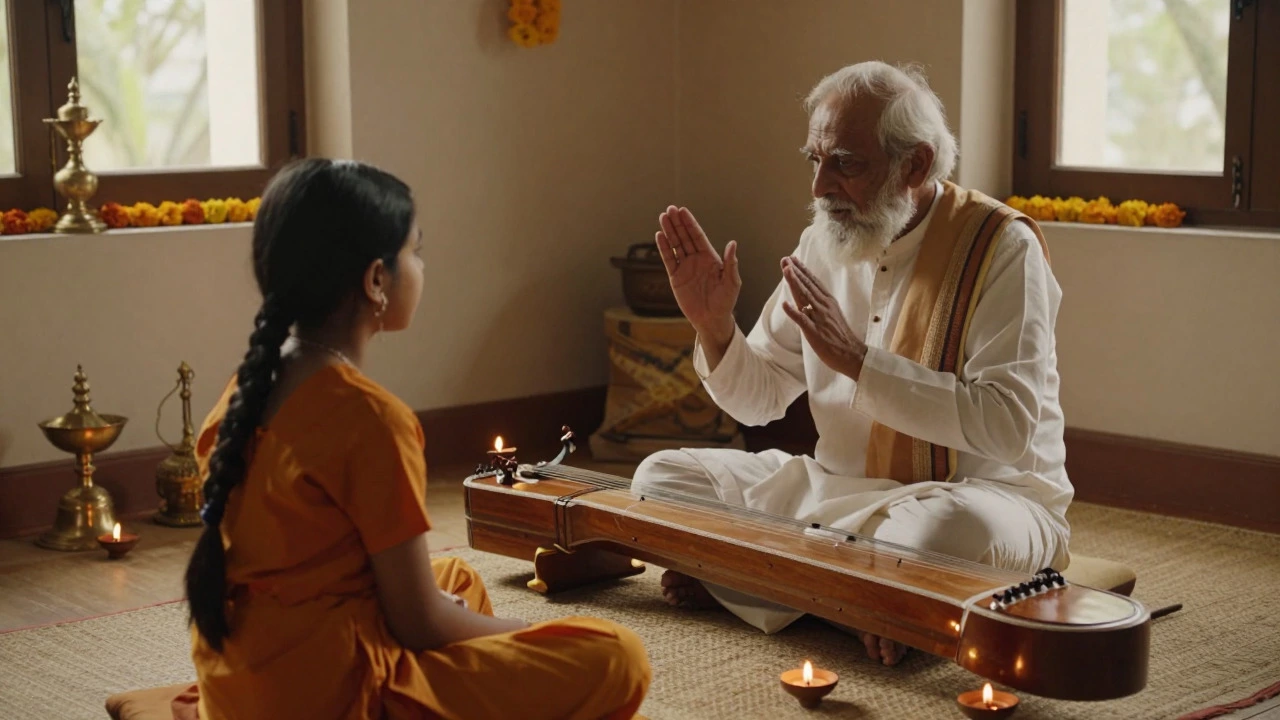
Unlike Western classical music, which often relies on sheet music and fixed compositions, this tradition is heavily oral. Knowledge is passed down from teacher to student through a method called Guru-Shishya Parampara. This ensures that the subtle nuances of ornamentation and improvisation are preserved authentically across generations.
Core Components: Raga and Tala
If you want to grasp the structure of this music, you must understand two fundamental concepts: Raga and Tala. These are not just scales or beats; they are living frameworks for expression.
A Raga is a melodic framework for improvisation. Think of it as a specific mood or personality expressed through notes. Each raga has rules about which notes can be used, how they should be approached, and even the time of day or season it is best suited for. For example, Raga Bhairavi is often performed in the morning and is considered a universal raga because it can accommodate various emotions. There are hundreds of ragas, each with its own character.
Tala refers to the rhythmic cycle. Unlike simple 4/4 time signatures in pop music, talas in this tradition can be complex, such as Adi Tala (8 beats) or Rupaka Tala (6 beats). The interplay between melody and rhythm creates a dynamic tension that keeps listeners engaged. Musicians often engage in rhythmic dialogue with percussionists, showcasing their ability to improvise within these strict structures.
Key Instruments Used in Performances
The sound of this music is defined by specific instruments that complement the human voice. The most important accompaniment instrument is the Tanpura. This long-necked string instrument provides a continuous drone, establishing the tonal center for the performer. Without the tanpura, the microtonal variations essential to the raga would lose their reference point.
For rhythmic support, the Mridangam is the primary drum. It is a double-headed barrel drum capable of producing a wide range of tones and complex rhythmic patterns. Other common instruments include the Violin, which was adapted from European origins but plays using techniques similar to vocal singing, and the Veena, particularly the Saraswati Veena, which is one of the oldest string instruments in India and produces a rich, resonant tone.
| Instrument | Role | Key Characteristic |
|---|---|---|
| Tanpura | Drone | Provides constant harmonic reference |
| Mridangam | Percussion | Complex rhythmic cycles and dialogues |
| Violin | Accompaniment/Solo | Mimics vocal ornamentation |
| Veena | Solo/Accompaniment | Rich, resonant plucked strings |
Structure of a Performance
A typical concert follows a structured format that builds in intensity. It usually begins with a Varnam, a short piece designed to warm up the vocalist and demonstrate technical proficiency. This is followed by Kritis, which are the main compositions. Kritis are complex songs that combine lyrics, melody, and rhythm, often based on the works of the Trinity composers.
The performance may also include Ragam Tanam Pallavi, an advanced improvisational section where the artist explores a chosen raga, then a rhythmic pattern, and finally a self-composed theme. This segment showcases the musician’s creativity and mastery over both melody and rhythm. The concert typically ends with a light-hearted Tillana or Javali, providing a satisfying conclusion to the evening.
Differences Between Carnatic and Hindustani Music
While both traditions originate from the same ancient sources, they diverged significantly over time. Hindustani music, prevalent in North India, was influenced by Persian and Islamic cultures during the Mughal era. This led to differences in instrumentation, such as the use of the sitar and tabla, and a greater emphasis on instrumental solos.
In contrast, Carnatic music remained more closely tied to devotional themes and temple traditions. Vocal music holds a central place in the South Indian tradition, with instruments often mimicking the voice. Additionally, the theoretical approach differs: Carnatic music uses a systematic classification of ragas based on parent scales, whereas Hindustani music groups them into families called thaat.
Why This Music Matters Today
You might wonder why this ancient art form remains relevant in the 21st century. The answer lies in its adaptability and emotional depth. Artists like MS Subbulakshmi brought this music to global audiences, proving its universal appeal. Today, younger musicians are experimenting with fusion genres, blending traditional ragas with jazz, electronic, and rock elements.
Moreover, the practice of learning this music offers cognitive benefits. Studies suggest that mastering complex rhythmic patterns and melodic structures enhances memory, concentration, and mathematical thinking. For many, it is not just entertainment but a spiritual discipline that fosters mindfulness and inner peace.
Getting Started with Carnatic Music
If you are interested in exploring this tradition, start by listening to recordings of the Trinity composers. Focus on the clarity of the vocals and the intricacy of the accompaniments. Attend local concerts if possible, as live performances offer a unique experience that recordings cannot fully capture. Consider taking introductory classes to learn basic ragas and talas. Many online platforms now offer resources for beginners, making it easier than ever to connect with this rich cultural heritage.
What is the main difference between Carnatic and Hindustani music?
The main differences lie in their historical influences and structural approaches. Hindustani music was influenced by Persian culture and emphasizes instrumental solos, while Carnatic music is rooted in temple traditions and prioritizes vocal performance. Additionally, Carnatic music uses a more systematic classification of ragas.
Who are the Trinity of Carnatic Music?
The Trinity consists of Tyagaraja, Muthuswami Dikshitar, and Syama Sastri. These three 18th-19th century composers created the bulk of the standard repertoire still performed today.
What is a Raga in Carnatic music?
A Raga is a melodic framework that defines the scale, note relationships, and emotional character of a piece. It serves as the basis for improvisation and composition.
Which instruments are commonly used in Carnatic music?
Common instruments include the Tanpura (drone), Mridangam (percussion), Violin, and Veena. The voice is considered the primary instrument, with others serving to accompany or mimic it.
Is Carnatic music only religious?
While much of the repertoire is devotional, Carnatic music also includes secular themes such as love, nature, and social commentary. Modern artists continue to expand the thematic range.