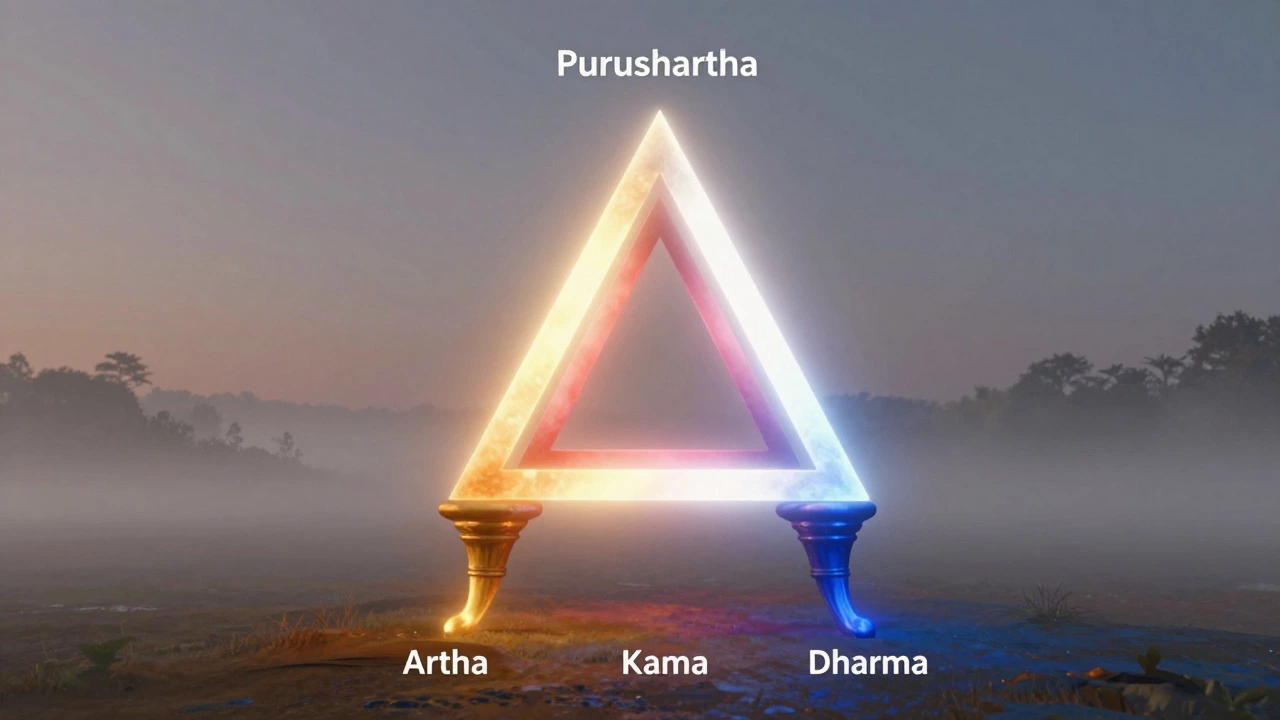
Purushartha Life Balance Calculator
According to Indian philosophy, a balanced life requires attention to four pillars (Purushartha). Rate your current satisfaction in each area on a scale of 1 to 10.
Your Results
Have you ever stopped to wonder why we are here? Most of us go through the motions-wake up, work, sleep, repeat. But beneath that routine lies a deeper question: what is the actual point of it all? In the West, we often chase success or happiness as the end goal. But if you look at Indian Philosophy, which has been mapping the human experience for thousands of years, the answer is far more complex-and honestly, much more satisfying.
Life, according to these ancient traditions, isn't just about surviving or accumulating stuff. It’s a structured journey with specific milestones. It’s not a straight line; it’s a spiral. You might feel like you’re going in circles, but each loop takes you higher. To understand this, we have to look past the stereotypes of yoga pants and incense and dive into the heavy hitters: the Vedas, the Upanishads, and the schools of thought that have shaped billions of lives.
The Four Goals of Human Existence
If you ask a traditional scholar in Varanasi or a modern philosopher in Mumbai what life is for, they will likely point you toward a concept called Purushartha, which translates to "the aims of human life". This isn’t a vague wish list. It’s a framework designed to keep your life balanced. Think of it like a four-legged stool. If one leg is missing, the whole thing collapses.
- Kama (Desire): Yes, desire is important. This includes pleasure, love, aesthetic enjoyment, and emotional fulfillment. Indian philosophy doesn’t shame you for wanting things. It says, enjoy them, but don’t let them own you.
- Artha (Wealth): You need resources to survive and thrive. Artha covers career, finance, and political power. Without Artha, it’s hard to practice the other goals. Money isn’t evil here; it’s a tool.
- Dharma (Righteousness): This is the glue. Dharma means duty, ethics, and moral order. It’s doing what is right, even when no one is watching. Your Dharma changes depending on who you are-a student has different duties than a parent, who has different duties than a retiree.
- Moksha (Liberation): The ultimate goal. This is freedom from the cycle of birth and death. It’s realizing your true self beyond the ego.
Most people get stuck chasing Kama and Artha while ignoring Dharma. That’s where stress comes from. When you act without Dharma, your wealth (Artha) becomes unstable, and your pleasures (Kama) turn into anxiety. The philosophy argues that a good life requires all four, with Moksha as the final horizon.
Karma: The Law of Cause and Effect
You’ve probably heard the word "karma" thrown around in pop culture. "They got their karma." But in Vedic thought, karma is strictly causal. It’s not cosmic punishment or reward. It’s physics applied to consciousness. Every action creates an impression in your mind, known as a Samskara. These impressions shape your future reactions.
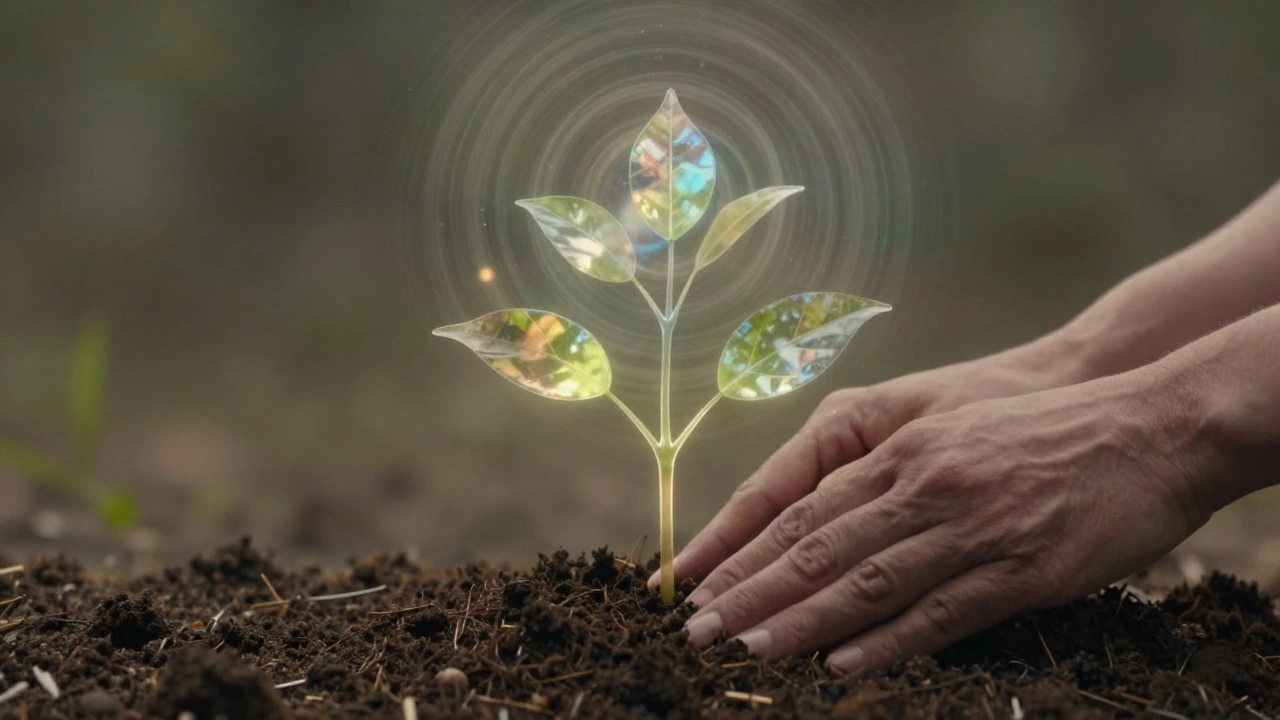
Imagine planting a seed. If you plant a mango seed, you won’t get an apple. That’s simple biology. Now apply that to behavior. If you act with anger, you cultivate anger. You become someone who reacts angrily. This limits your freedom. Conversely, acting with compassion cultivates peace. Over time, these patterns define your character and your circumstances.
This brings us to a crucial distinction: Nishkama Karma, or action without attachment to results. This concept, heavily featured in the Bhagavad Gita, a sacred Hindu text, suggests that you should do your best work, but let go of the outcome. Why? Because obsessing over the result causes suffering. If you tie your happiness to getting a promotion, you suffer when you don’t get it. If you focus on doing excellent work regardless of the promotion, you remain steady. This isn’t passive resignation; it’s active engagement with emotional stability.
The Cycle of Samsara and the Illusion of Maya
So, why are we reborn? Indian philosophy posits that individual souls, or Atman, are eternal, but they are trapped in Samsara, the cycle of birth, death, and rebirth. We return because we still have unfulfilled desires and unresolved karmic debts. As long as you identify with your body, your job, or your opinions, you are bound to this wheel.
But here’s the twist: the world you see is also considered Maya, or illusion. This doesn’t mean the world isn’t real-it’s very real. But it means the world is not *all* there is. Maya is like a movie projection. The screen is real, the light is real, but the story playing out is temporary and changing. When you cry over a tragic scene in the film, you forget you’re in a theater. Similarly, we suffer because we take the temporary drama of life too seriously, forgetting our deeper nature as the witness, not the actor.
This view shifts how you handle loss. If everything is impermanent (Anicca), then grief is natural, but clinging is unnecessary. Understanding Maya helps you participate in life fully without being destroyed by its ups and downs.
Schools of Thought: Not All Indians Think Alike
One mistake people make is thinking "Indian Philosophy" is a monolith. It’s not. There are six orthodox schools (Astika) that accept the authority of the Vedas, and three heterodox schools (Nastika) that don’t. Each offers a different lens on life.
| School | View on God | Path to Liberation | Key Concept |
|---|---|---|---|
| Vedanta | Brahman (Ultimate Reality) | Jnana (Knowledge) & Bhakti (Devotion) | Atman is Brahman |
| Samkhya | Agnostic/Theistic | Discrimination between Self and Matter | Purusha (Consciousness) vs Prakriti (Nature) |
| Yoga | Ishvara (Personal God) | Eight Limbs of Yoga | Cessation of mental fluctuations |
| Buddhism | No Creator God | Noble Eightfold Path | Anatta (No-Self) & Emptiness |
| Jainism | Enlightened Beings (Tirthankaras) | Ahimsa (Non-violence) & Asceticism | Anekantavada (Many-sidedness) |
For example, Advaita Vedanta, popularized by Adi Shankara, teaches non-dualism. It says there is only one reality, and separation is an illusion. On the other hand, Dvaita Vedanta, taught by Madhvacharya, argues that God and the soul are eternally distinct. Then you have Buddhism, which rejects the idea of a permanent soul altogether, focusing instead on ending suffering through mindfulness and ethical living. Jainism emphasizes radical non-violence, arguing that every living being has a soul worth respecting. This diversity shows that Indian philosophy encourages inquiry, not blind faith.

Practical Wisdom for Modern Life
You don’t need to live in an ashram to benefit from these ideas. In fact, applying them in a corporate office or a suburban home can be revolutionary. How?
First, embrace Dharma in your daily choices. Before making a decision, ask: "Is this aligned with my core values?" If you cut corners at work to make money, you violate Dharma. The short-term gain might come, but the long-term cost is integrity. Second, practice detachment from outcomes. Try doing a task purely for the joy of doing it well, not for the praise. Notice how your anxiety drops.
Third, recognize the role of Maya. When you’re angry in traffic, remember that the situation is temporary. Don’t let external events hijack your internal peace. This isn’t suppression; it’s perspective. Finally, use Karma as a feedback loop. If you’re unhappy, look at your actions. Are you sowing seeds of conflict or connection? Change the input, and the output will follow.
Living a Meaningful Life Today
Ultimately, what is life in Indian philosophy? It is a school. You are here to learn, to grow, and to eventually graduate from the illusion of separateness. It’s not about escaping the world, but engaging with it wisely. By balancing desire, wealth, duty, and spiritual growth, you create a life that is not just successful, but significant. The ancient texts aren’t dusty relics; they are operating manuals for the human mind. The question is, are you ready to read them?
Is Indian philosophy religious?
Not necessarily. While many schools are rooted in Vedic traditions, concepts like logic (Nyaya), atomism (Vaisheshika), and psychology (Yoga) are philosophical and rational. You can study these systems as metaphysics or ethics without adopting any specific religious belief.
What is the difference between Atman and Brahman?
In Advaita Vedanta, Atman is the individual soul, and Brahman is the universal reality. The core teaching is that they are identical: "Tat Tvam Asi" (Thou Art That). In dualistic schools, however, Atman remains distinct from Brahman forever.
How does Karma differ from fate?
Fate implies a pre-written script where you have no control. Karma is dynamic. While past actions influence your present circumstances, your current actions determine your future. You always have the free will to change your trajectory.
Can I practice Dharma in a secular society?
Absolutely. Dharma simply means acting in accordance with truth and duty. In a secular context, this translates to professional ethics, civic responsibility, and personal integrity. It is universal, not just cultural.
What is the role of meditation in Indian philosophy?
Meditation (Dhyana) is a primary tool in Yoga and Vedanta for quieting the mind. It allows you to observe your thoughts without identification, leading to self-realization and clarity. It is considered essential for moving from intellectual understanding to direct experience.