Family Support Calculator
How Strong is Your Family Support?
This tool helps you understand the strength of family support in Indian culture based on real-life scenarios.
Ask someone what the biggest tradition in India is, and you’ll get a dozen answers. Diwali? Yoga? Arranged marriages? The way people greet elders with folded hands? All of these are deep, meaningful, and widespread. But if you want to find the one tradition that touches every single person across every state, language, and religion - from the Himalayas to Kanyakumari, from Mumbai slums to Punjabi farms - it’s not a festival, a ritual, or a dance. It’s the family.
Not just the idea of family. Not just the word. The daily, unspoken, non-negotiable practice of living as one unit - where meals are eaten together, decisions are made as a group, and no one is ever truly alone. This isn’t just about living under one roof. It’s about shared responsibility, shared identity, and shared survival. In India, family isn’t a social preference. It’s the operating system of life.
Think about it: when a child is born, the whole extended family shows up - grandparents, aunts, uncles, cousins. They don’t just bring gifts. They cook, clean, hold the baby, and sleep in shifts so the new parents can rest. When someone gets sick, relatives drop everything. A job loss? The family pool kicks in. A wedding? Every relative, no matter how distant, is invited - and expected to contribute. There’s no such thing as "just my problem." Everything is "our problem."
This isn’t romanticized. It’s survival. For centuries, India’s economy, infrastructure, and social safety nets were built on family networks. If you needed healthcare, education, or even a place to sleep, you didn’t call a government agency. You called your uncle, your cousin, your mother’s sister’s husband. The family was your bank, your hospital, your college, and your insurance policy. Even today, with smartphones and apps, this hasn’t changed. It’s just evolved.
How Family Shows Up in Everyday Life
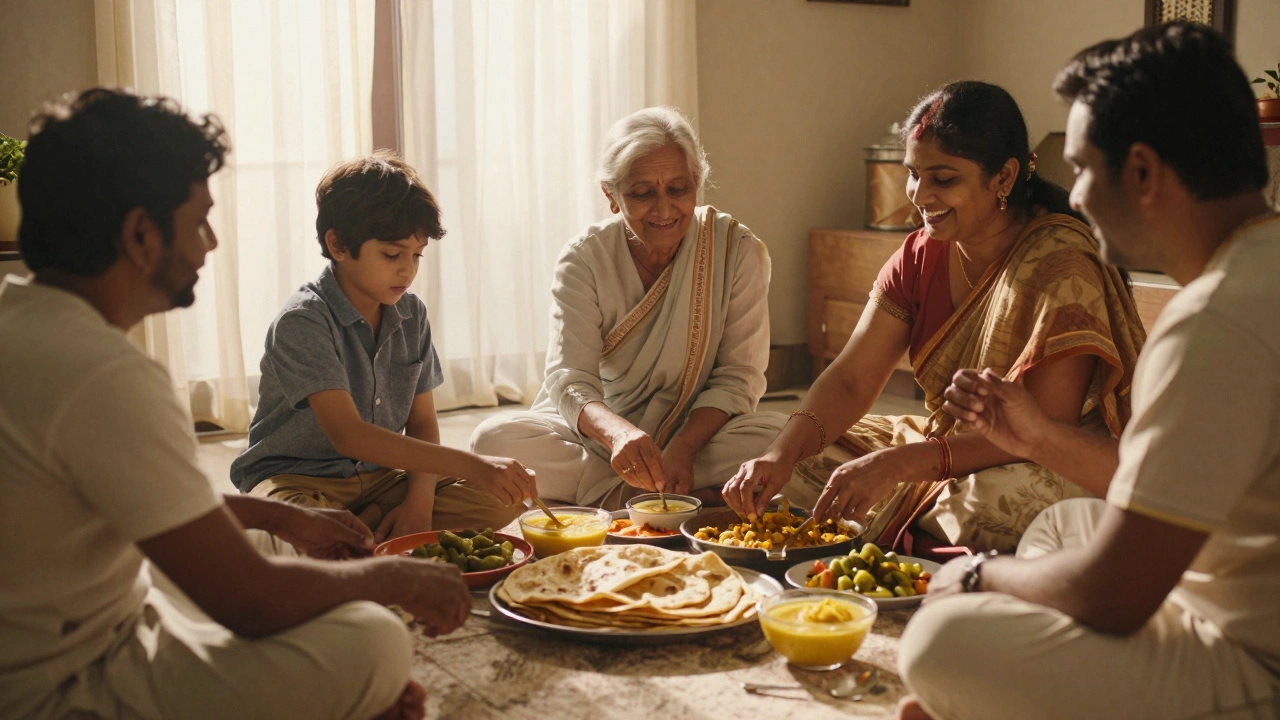
You see it in the morning. In a typical Indian home, breakfast isn’t served on individual plates. It’s placed in the center - roti, dal, pickles - and everyone eats from the same platter. No one starts eating until the eldest has taken the first bite. In cities, where space is tight, families still eat together. In villages, where space is wide, they eat outside under the same tree.
When a young person gets a job in another city, they don’t just move out. They move their parents in with them - if they can afford it. If not, they send money home every month. Not because they’re obligated by law. Because they’re obligated by love. And that love isn’t spoken about. It’s shown in the way a daughter saves her salary to pay for her brother’s wedding, or how a son drops his weekend plans to drive his mother to a doctor’s appointment three towns away.
Even in divorce, the family stays. A woman might leave her husband, but she doesn’t leave her in-laws. She still calls them "Bhabhi" or "Dadi." They still invite her to festivals. Why? Because in India, marriage doesn’t create a new family - it connects two existing ones. The wife doesn’t become "his wife." She becomes "their daughter-in-law." Her identity is absorbed into the family’s.
Why It’s Not Just About Religion
Some might say this is a Hindu tradition. But it’s not. Muslims in Kerala, Christians in Goa, Sikhs in Punjab, Jains in Rajasthan - they all live this way. A Christian family in Bangalore might celebrate Christmas with a midnight mass, but they still sit down for dinner with all six generations under one roof. A Sikh family in Delhi might wear turbans and visit the gurdwara daily, but they still ask their grandmother’s blessing before making a big decision.
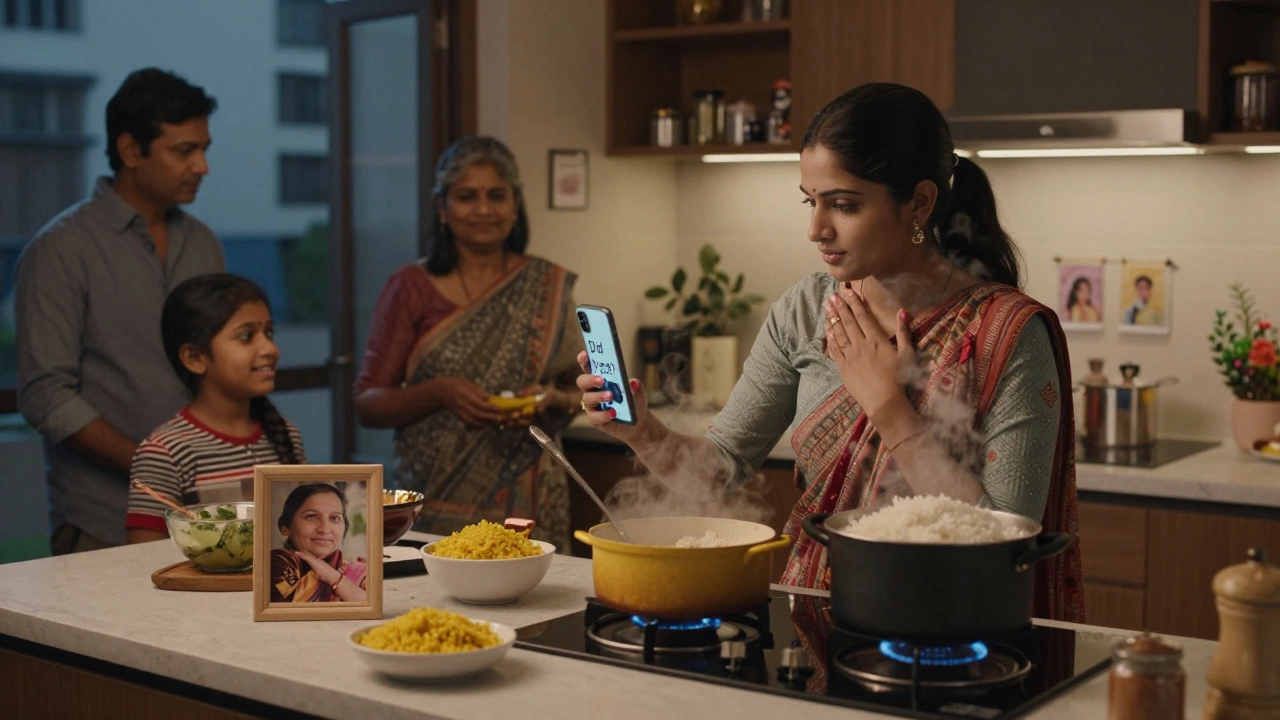
India has over 22 official languages and hundreds of dialects. It has more religions than most countries have people. Yet, across all of them, the family unit holds firm. It’s the one thread that doesn’t break. Even in cities like Hyderabad or Bengaluru, where young people work 12-hour days, they still call their parents three times a day. They still send photos of their food. They still ask, "Did you eat?" before hanging up.
It’s Not Always Easy
Let’s be real: this tradition isn’t perfect. It can be suffocating. Young people feel pressure to marry early, to take over the family business, to not pursue careers that "aren’t respectable." Women are expected to give up jobs after marriage. Elders sometimes make decisions without asking.
But here’s the thing - the people who leave this system often come back. Not because they failed. But because they missed it. They missed the sound of their mother’s voice calling them for tea. They missed the smell of their grandmother’s cooking. They missed knowing that no matter how bad their day was, someone was waiting for them with a plate of food and no questions asked.
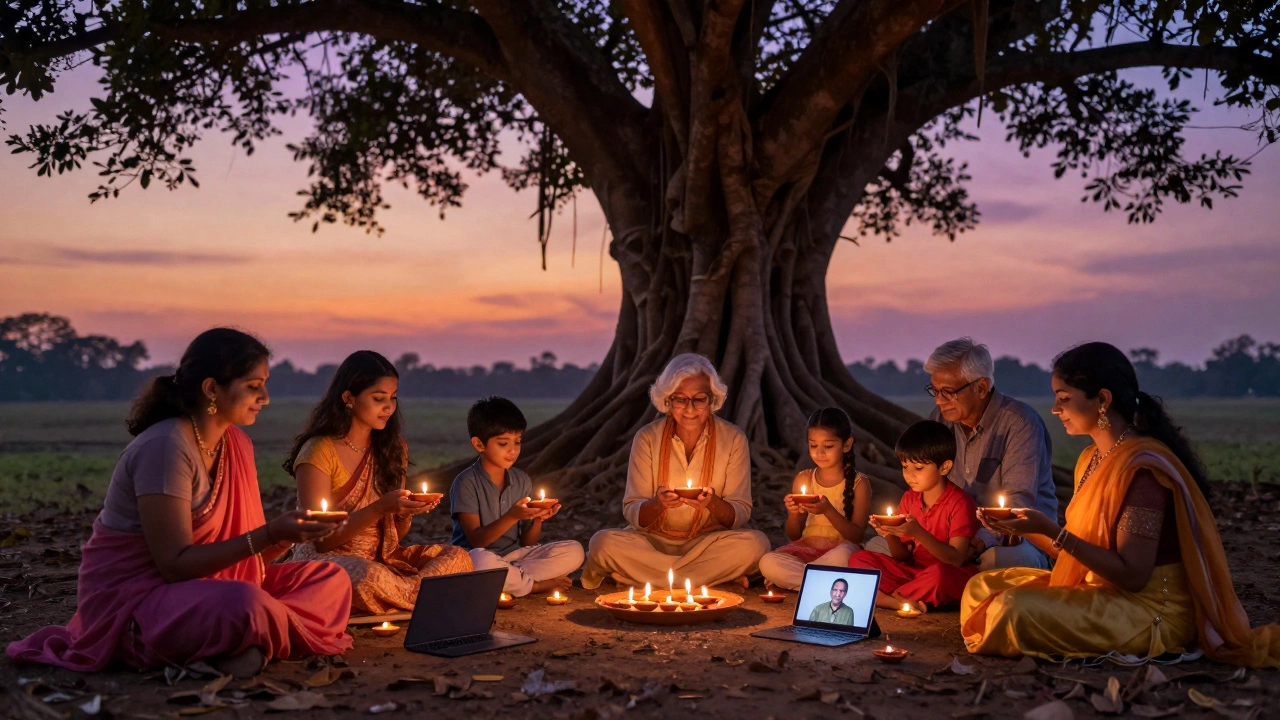
Studies show that Indians living abroad report higher levels of loneliness than any other immigrant group - not because they’re isolated, but because they miss the constant, quiet presence of family. Even in Toronto, where I live, Indian families host weekly dinners for 15 people. They fly grandparents in for birthdays. They video call during Diwali so everyone can light diyas together, even if they’re on different continents.
How This Tradition Survives Modernity
Technology didn’t kill this tradition. It amplified it. WhatsApp groups with 87 members. Group video calls on holidays. Parents sending voice notes instead of texts. Young people using apps to send money home instantly. Social media isn’t replacing family - it’s connecting it.
Even dating apps in India now have filters like "family-oriented" or "willing to live with parents." Companies offer "family leave" - not just for parents, but for grandparents. Schools host "family days" where three generations show up. The system adapts, but the core doesn’t change.
When a young Indian moves to the U.S. or Australia, they don’t just bring their passport. They bring their values. They cook dal at 2 a.m. because their roommate doesn’t know how. They invite colleagues to Diwali parties. They explain why they can’t work on certain days - not because they’re being difficult, but because it’s their mother’s birthday, and she’s been waiting for them to call since sunrise.
Why This Tradition Matters Beyond India
Globalization talks about individualism. Western media celebrates independence. But India shows another way: belonging. Not as a cage, but as a comfort. Not as a restriction, but as a root.
In a world where people feel more alone than ever, India’s biggest tradition offers something rare: a guarantee. You will never be alone. Someone will always remember your favorite snack. Someone will always save a seat for you at the table. Someone will always wait up for you.
That’s not nostalgia. That’s not folklore. That’s daily reality for over 1.4 billion people. And it’s not fading. It’s growing - in villages, in cities, in diaspora homes from London to Los Angeles.
The biggest tradition in India isn’t fireworks or fasting. It’s showing up. Every day. For each other.
Is Diwali the biggest tradition in India?
Diwali is the most visible and widely celebrated festival in India, but it’s not the deepest-rooted tradition. Diwali lasts a few days. Family is there every single day - through illness, birth, loss, and celebration. Diwali is a moment. Family is the constant.
Do all Indian families live together?
Not literally under one roof - especially in big cities. But emotionally and financially, they still operate as one unit. Even if parents live separately, they’re consulted on every major decision. Money, marriage, career moves - all go through family discussion. Physical distance doesn’t break the bond.
Is this tradition changing with younger generations?
It’s evolving, not disappearing. Younger Indians are choosing careers abroad, delaying marriage, or living alone. But they still call their parents daily. They still send money home. They still plan visits around festivals. The structure is changing, but the emotional core remains untouched.
Why do Indian families care so much about what others think?
It’s not about judgment - it’s about connection. In a culture where identity is tied to family, your actions reflect on everyone. That pressure isn’t just social control. It’s a form of collective care. When your cousin gets married, your whole family feels joy. When you fail, your whole family feels the sting. That’s the weight - and the strength - of the system.
Can someone be Indian without following this tradition?
Yes, absolutely. Being Indian isn’t defined by one practice. But if you want to understand what makes Indian culture unique, this tradition is the foundation. Even those who reject it often miss it - and many return to it later in life. It’s not a rule. It’s a rhythm most people still feel in their bones.
Next time you see a video of an Indian wedding with 500 guests, or a family of seven crammed into a tiny kitchen cooking together, don’t think of it as "overwhelming." Think of it as a quiet revolution - a way of life that says: you are never alone. And that’s worth more than any festival, any temple, any song.