
Motivation Source Analyzer
Which of these statements resonates most with you right now? Select the one that best describes why you want to achieve your goal.
Key Takeaways
- Intrinsic motivation (internal purpose) lasts far longer than extrinsic rewards (money, fame).
- The strongest drive often comes from "Pain Avoidance" or a deep sense of responsibility toward others.
- Motivation is a fluctuating emotion; systems and habits are what actually produce results.
- Aligning your daily actions with a core identity creates an unstoppable psychological loop.
The Battle Between Internal and External Drives
To understand what actually moves us, we have to look at where the push comes from. In psychology, we generally split this into two camps. First, there is Extrinsic Motivation is the drive to perform a task to earn a reward or avoid a punishment from an external source. Think of a sales commission, a trophy, or the desire for a promotion. While these are powerful, they have a major flaw: they have a ceiling. Once you get the car or the title, the motivation often vanishes, leading to what researchers call the "hedonic treadmill."
Then there is Intrinsic Motivation is the act of doing something because it is inherently rewarding, enjoyable, or aligned with one's personal values. This is the programmer who spends ten hours coding a project for free just because they love the puzzle. This is the strongest form of long-term motivation because the reward is the process itself. When the work is the reward, you don't need an external carrot to keep moving.
| Feature | Extrinsic Drive | Intrinsic Drive |
|---|---|---|
| Source | External (Money, Praise) | Internal (Passion, Purpose) |
| Duration | Short-term / Episodic | Long-term / Sustainable |
| Risk | Burnout when reward stops | Over-focus on a single passion |
| Example | Working for a yearly bonus | Learning a language for curiosity |
The Dark Side of Drive: Pain as a Catalyst
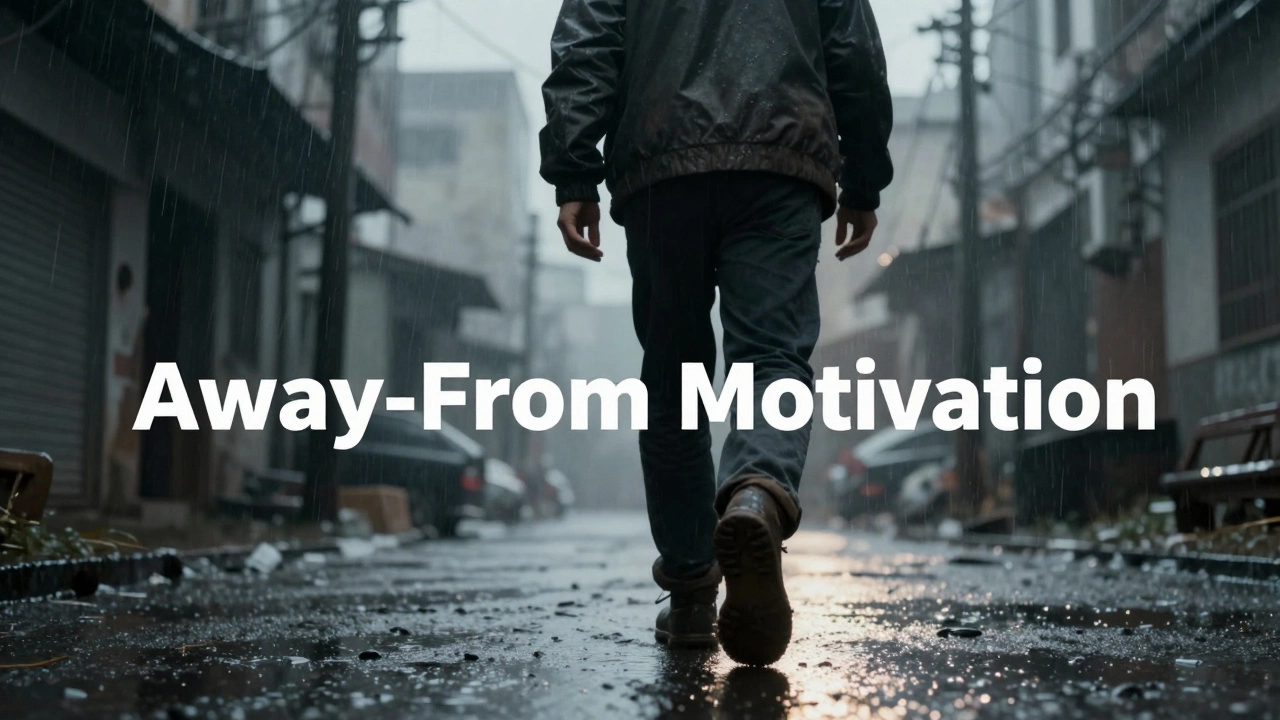
We often talk about passion and love, but let's be honest: some of the most incredible achievements in human history were born out of desperation. There is a concept in behavioral science known as "negative reinforcement." For many, the strongest motivation isn't the desire for a better life, but the absolute refusal to continue living the current one. This is often called "Away-From Motivation."
Think about a person who grew up in poverty and vowed they would never let their children experience the same struggle. That isn't a "positive" emotion like joy or passion-it is a memory of pain. However, that pain acts as a high-octane fuel. When you are running away from a version of your life that you hate, you can work 18-hour days without feeling the fatigue that stops others. The fear of returning to a place of scarcity is a biological trigger that overrides the brain's desire for comfort.
The Role of Identity and the 'Why'
If pain is the spark, identity is the engine. Most people try to change their outcomes first (e.g., "I want to lose 20 pounds"). But the most successful people change their identity first. This is rooted in Cognitive Dissonance is the mental discomfort experienced by a person who holds two or more contradictory beliefs, ideas, or values. If you believe "I am an athlete," then skipping a workout creates a mental conflict that is uncomfortable to ignore.
This shift is where motivational quotes actually become useful. A quote isn't magic; it's a tool to shift your self-perception. When you read a line about resilience, you aren't just absorbing a sentence; you are reminding yourself of the identity you want to embody. The strongest drive comes when your daily actions are not a chore, but a requirement for maintaining who you believe you are. You don't "try" to work hard; you work hard because that is what a person of your caliber does.
Why Motivation Always Fails You
Here is the uncomfortable part: motivation is a feeling, and feelings are unreliable. You cannot rely on a feeling to build a business, raise a child, or master a skill. If you only work when you "feel" motivated, you are at the mercy of your mood, your sleep quality, and the weather. The secret of the high-achiever is that they actually rely on motivation very little.
Instead, they use Systems Theory is the study of systems as a whole, focusing on how different parts of a process interact to produce a specific outcome. They build a routine so rigid that the decision to work is already made. When the environment is set up for success-like putting your gym clothes out the night before-you remove the need for willpower. Willpower is a finite resource; systems are infinite.

Connecting Drive to Social Responsibility
Finally, there is the "transcendental" drive. While intrinsic motivation is about the self, the strongest force in the human psyche is often the desire to serve something larger than the self. This is why people will risk their lives for their children or spend decades fighting for a social cause. When your motivation shifts from "I want this" to "They need me to do this," the capacity for endurance increases exponentially.
This is the highest level of the hierarchy. When you link your goals to the wellbeing of others-your family, your community, or a future generation-you tap into a reservoir of strength that doesn't dry up. You stop asking "Do I feel like doing this today?" and start asking "Who will suffer if I don't do this today?" That shift in perspective turns a fragile wish into an unbreakable obligation.
Can you create motivation if you don't have any?
Yes, but not by waiting for a feeling. Motivation often follows action, not the other way around. The "Action-Motivation-Action" loop suggests that taking a tiny, 5-minute step creates a small win, which releases dopamine, which then provides the motivation to take the next step. Start with a task so small it's impossible to fail.
What is the difference between discipline and motivation?
Motivation is the emotional desire to do something; it's the fuel that gets you started. Discipline is the ability to do that thing even when you hate it. Motivation is a sprint; discipline is the marathon. If you rely on the former, you'll stop when the wind changes. If you build the latter, you'll finish regardless of the weather.
Why do I lose motivation after achieving a goal?
This is the "Arrival Fallacy." It's the belief that once you reach a destination, you'll be permanently happy. Because the brain adapts to new levels of success (hedonic adaptation), the reward value drops. To fix this, shift your focus from the goal (the destination) to the system (the journey). Enjoy the process of becoming the person who can achieve the goal.
Are negative emotions like anger or fear good motivators?
In the short term, yes. Anger and fear are powerful catalysts for change. However, they are biologically expensive. Living in a state of high cortisol and stress leads to burnout and poor decision-making. The trick is to use the negative spark to get started, but then transition to a positive, purpose-driven drive to sustain the effort.
How do motivational quotes actually help?
They act as "pattern interrupts." When you are spiraling into doubt or laziness, a well-timed quote can shift your mental state and remind you of your chosen identity. They are best used as triggers to return to your systems, rather than as a replacement for the systems themselves.
Next Steps for Strengthening Your Drive
If you feel your drive slipping, stop looking for a new quote and start looking at your structure. For the person who feels burnt out, the answer is usually rest and a reconnection with their "Why." For the person who is procrastinating, the answer is reducing the friction of the first step. Ask yourself: "Who is relying on me to succeed?" Once you answer that, you've found the strongest motivation there is.