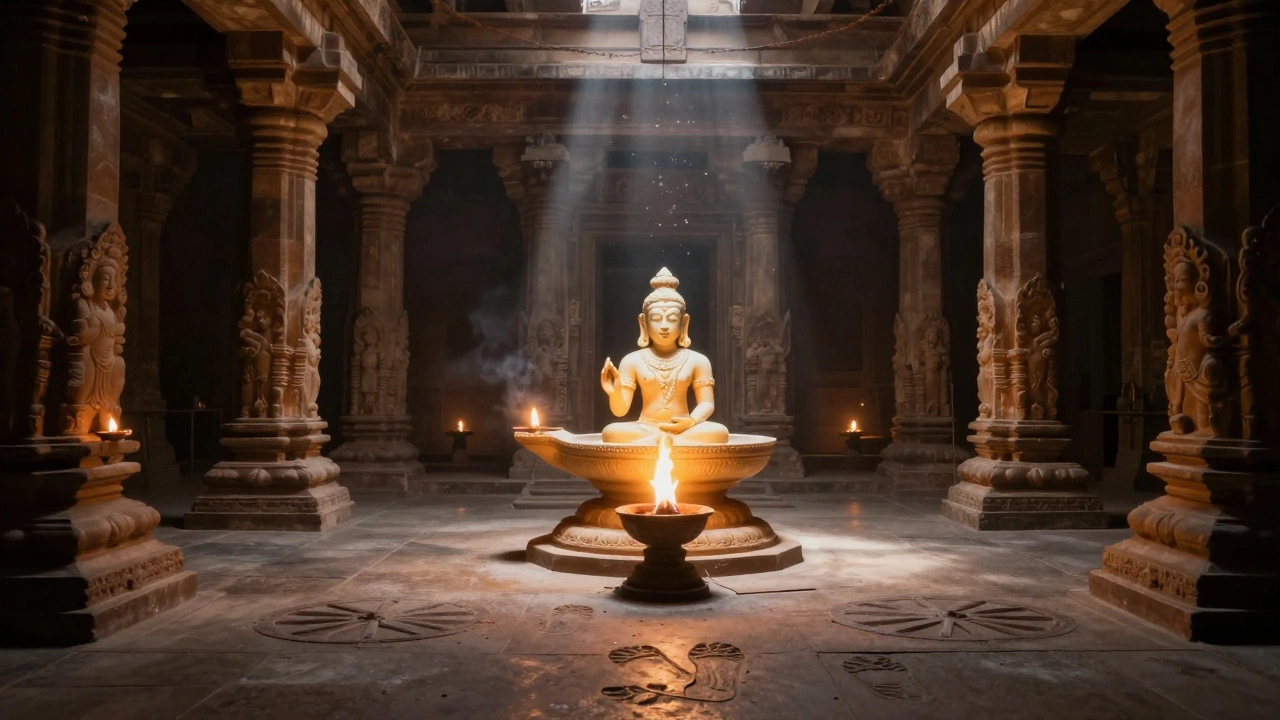
Indian Art Schools Comparison
Compare the key characteristics, materials, and influences of the major ancient Indian art schools that shaped divine imagery.
| School | Region | Material | Key Characteristics | Influence |
|---|---|---|---|---|
| Gandhara | Pakistan/Afghanistan | Grey Schist | Greek realism, wavy hair, draped robes | Introduced anthropomorphic forms |
| Mathura | Uttar Pradesh | Red Sandstone | Indigenous style, luminous finish, robust forms | Defined classic Hindu iconography |
| Amaravati | Andhra Pradesh | White Marble | Fluid movement, intricate detail, narrative scenes | Influenced Southeast Asian art |
Walk into any temple in India today, and you will see them. Shiva with his third eye, Vishnu holding his conch shell, Ganesha with his elephant head. They look familiar, almost like family members you’ve known your whole life. But have you ever stopped to ask: who decided they should look like that?
For centuries, people assumed these images were eternal. We thought the gods always had faces, bodies, and specific attributes. The truth is much more interesting. For the first thousand years of Hinduism, there were no statues. No paintings. No idols. Worship was abstract, focused on fire rituals and symbols like the Shiva Linga, a smooth stone representing cosmic energy. The question of "who gave face to the Indian gods" isn't just about art; it's about a massive cultural shift that changed how billions of people relate to the divine.
The Age of Aniconism: When Gods Had No Faces
To understand who created the images, we first need to understand what came before. Between 500 BCE and 100 CE, early Hindu traditions practiced what scholars call aniconism. This means "without images." You wouldn't find a statue of Krishna or Rama during this period. Instead, worshipers looked at footprints, empty thrones, or wheels. These were called Pratimā symbols used as proxies for the deity.
Why? It wasn't because artists couldn't carve stone. It was a theological choice. Early thinkers believed the ultimate reality (Brahman) was formless and beyond human comprehension. Trying to put God into a box made of marble felt wrong. It limited the infinite. So, while Buddhism and Jainism were starting to experiment with human forms, mainstream Hinduism stuck to symbols. If you walked through an ancient site from this era, you’d see grand temples, but the sanctums would be empty or hold only simple objects.
The Great Shift: Why Images Appeared Around 100 CE
Then, something changed. Around the 1st century CE, suddenly, statues started appearing. Who gave face to the Indian gods? It wasn’t one person. It was a collision of trade, philosophy, and artistic innovation across three major centers: Gandhara in modern-day Pakistan/Afghanistan, Mathura in Uttar Pradesh, and later, Amaravati in Andhra Pradesh.
This shift happened for two main reasons. First, religion became more personal. People didn't just want to perform rituals; they wanted to connect emotionally. A statue offers a face to look at, eyes to meet, and a presence to feel. Second, new schools of thought emerged that celebrated the physical body as a vessel for the divine. If the body is holy, then sculpting it beautifully is an act of worship.
Gandhara: The Greek Influence on Indian Divinity
Let’s start in the northwest. The Gandhara School of Art is famous for blending Indian spirituality with Hellenistic (Greek) aesthetics. After Alexander the Great’s campaigns, Greek influence lingered in this region for centuries. When Buddhist monks and Hindu artisans worked here, they picked up techniques from their Roman and Greek neighbors.
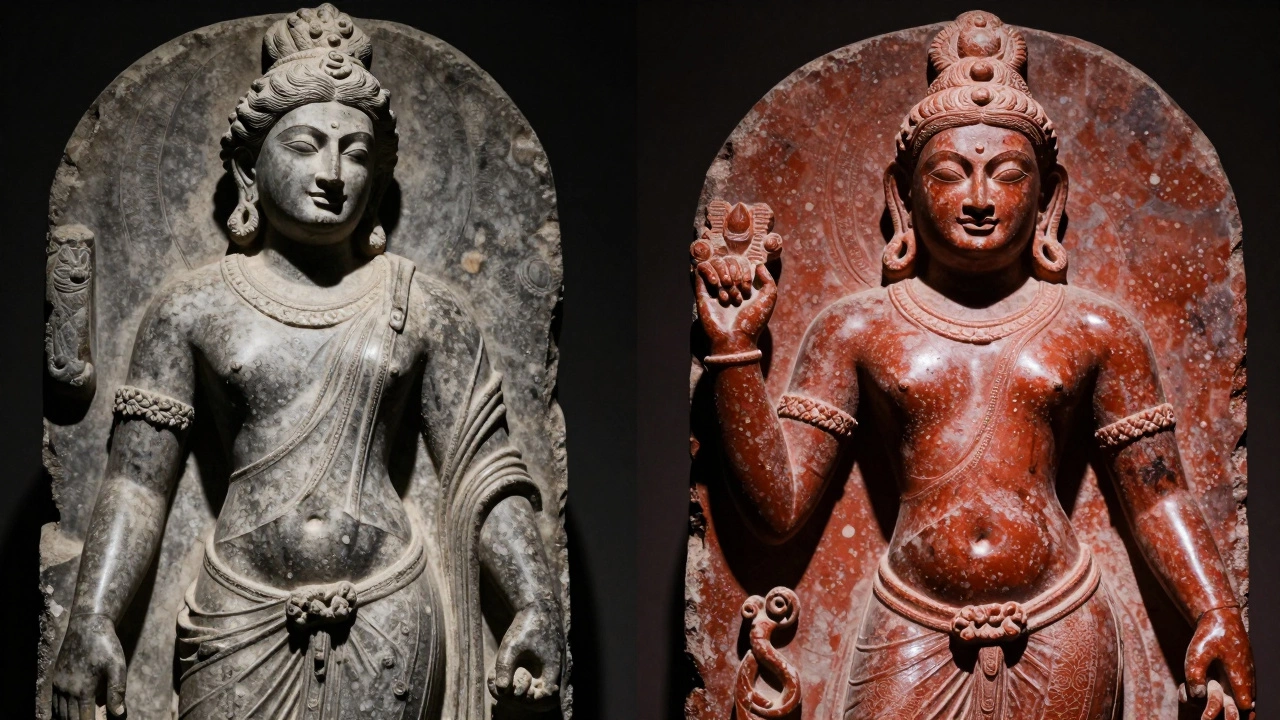
Look closely at early Gandharan statues of Buddha or Hindu deities. Do you see the wavy hair? The draped robes that cling to the body like wet fabric? The realistic facial features with high cheekbones and deep-set eyes? That’s classical Greek sculpture talking. Artists in Gandhara used grey schist stone and carved with chisels designed for marble. They brought a sense of realism and anatomy that hadn’t existed in Indian art before. While Gandhara is most famous for Buddhist images, this style heavily influenced how Hindu gods began to be visualized-standing tall, muscular, and human-like.
Mathura: The Indigenous Indian Style
While Gandhara looked west, Mathura looked inward. Located in the heartland of India, Mathura artists didn't care about Greek drapery. They used local spotted red sandstone and created a style that felt distinctly Indian. If Gandhara was cool and reserved, Mathura was warm and vibrant.
Mathuran sculptures are fuller, rounder, and more dynamic. The figures aren't just standing; they seem to breathe. The skin has a luminous quality, often polished to shine. This is where we see the birth of the classic Hindu god form. Early Mathura statues show Shiva and his consort Parvati not as distant philosophers, but as royal couples. They wear jewelry, crowns, and heavy garments. This style established the template for devotion: the gods as kings, accessible yet majestic. The Mathura school proved that you didn't need foreign influence to create powerful divine imagery; you just needed to understand the local soul.
Standardizing the Look: The Shilpa Shastras
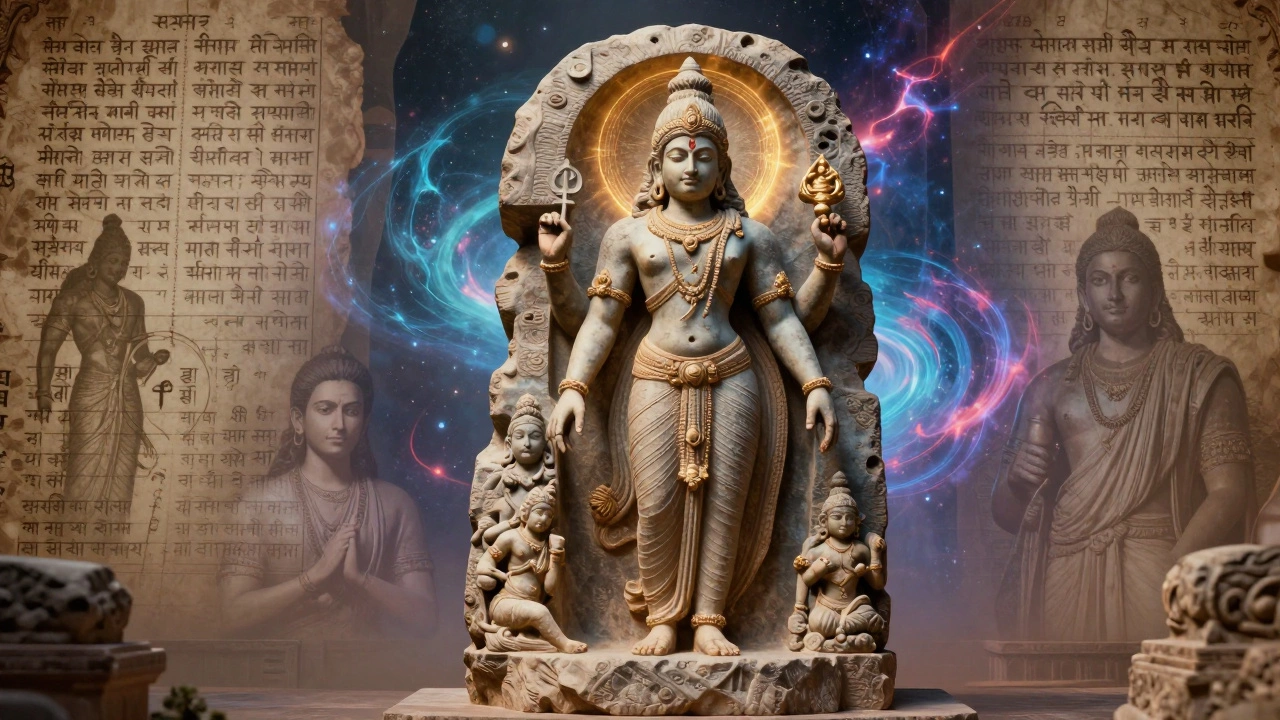
So, individual artists in Gandhara and Mathura started making statues. But how did everyone agree on what Vishnu *should* look like? How do we know he holds a discus (Sudarshana Chakra) and not a sword? Enter the Shilpa Shastras.
These are ancient treatises on art and architecture. Think of them as the instruction manuals for sculptors. Written between the 3rd and 15th centuries CE, these texts codified the rules of iconography. They specified exact proportions. For example, the distance from the chin to the navel should equal the distance from the navel to the top of the head. They dictated which hand held which object, which posture represented which mood, and even the number of fingers on each hand.
Without the Shilpa Shastras, every village might have had a different-looking Shiva. With them, a devotee traveling from Kerala to Kashmir could recognize the same divine form. These texts turned art into science. They ensured that the "face" given to the gods was consistent, sacred, and spiritually potent according to tradition.
| School | Region | Material | Key Characteristics | Influence |
|---|---|---|---|---|
| Gandhara | Pakistan/Afghanistan | Grey Schist | Greek realism, wavy hair, draped robes | Introduced anthropomorphic forms |
| Mathura | Uttar Pradesh | Red Sandstone | Indigenous style, luminous finish, robust forms | Defined classic Hindu iconography |
| Amaravati | Andhra Pradesh | White Marble | Fluid movement, intricate detail, narrative scenes | Influenced Southeast Asian art |
The Role of Patronage: Kings and Merchants
Art doesn't happen in a vacuum. Who paid for these statues? It wasn't just religious zealots. It was the Kushan Empire, the Gupta Empire, and wealthy merchant guilds. The Kushans controlled the Silk Road, bringing wealth and diverse cultures together. Their kings, like Kanishka, were huge patrons of art. They built stupas and temples to legitimize their rule and gain spiritual merit.
Later, the Gupta Empire (4th to 6th century CE) is often called the "Golden Age" of Indian art. During this time, the styles of Gandhara and Mathura merged into a refined, balanced aesthetic. Gupta sculptures are considered the peak of classical Indian art. They are serene, idealized, and perfectly proportioned. This was the moment when the "face" of the Indian gods became standardized and universally accepted. The patronage of these empires allowed artists to experiment, refine, and spread these images across the subcontinent.
From Stone to Screen: The Modern Evolution
Fast forward to today. The process of giving face to the gods hasn't stopped; it has just changed mediums. In the 20th century, cinema played a massive role. Actors like Prithviraj Kapoor, Dilip Kumar, and later Amitabh Bachchan and Hrithik Roshan, shaped how millions visualize Krishna, Ram, or Shiva. When you think of Lord Ram, do you see the ancient statue or the actor from the TV serial? For many, it’s the latter.
Digital art and CGI have taken this further. Modern filmmakers use computer-generated imagery to create gods with thousands of arms, glowing auras, and cosmic backgrounds. These images are less about anatomical accuracy and more about emotional impact. Yet, they still follow the old rules set by the Shilpa Shastras. The core identity remains, even if the texture changes from stone to pixels.
Why It Matters Today
Understanding who gave face to the Indian gods helps us appreciate the depth of our cultural heritage. It shows us that our traditions are not static. They evolved through interaction with Greece, Persia, and China. They adapted to new materials, new technologies, and new ways of thinking. The gods we worship today are the result of centuries of artistic dialogue, philosophical debate, and devotional love. Next time you see an image of a deity, take a closer look. You’re not just seeing a statue; you’re seeing history.
Did ancient Hindus worship idols?
Not initially. For the first millennium of Hinduism, worship was largely aniconic, focusing on symbols like the Shiva Linga or fire altars. Idol worship (murti puja) became prominent around the 1st century CE, driven by the rise of devotional movements and artistic innovations in schools like Mathura and Gandhara.
What is the difference between Gandhara and Mathura art?
Gandhara art blends Indian themes with Greek/Hellenistic styles, featuring realistic anatomy, wavy hair, and draped robes carved in grey schist. Mathura art is indigenous, using red sandstone to create robust, luminous figures with a more fluid and expressive Indian aesthetic.
What are the Shilpa Shastras?
The Shilpa Shastras are ancient Indian texts that serve as guidelines for art and architecture. They define the precise proportions, postures, and attributes for depicting deities, ensuring consistency in religious iconography across different regions and eras.
When did the first statues of Hindu gods appear?
The first anthropomorphic (human-shaped) statues of Hindu gods appeared around the 1st century CE, particularly in the Mathura region. This marked a significant shift from earlier symbolic worship to visual representation.
How did Greek influence affect Indian art?
Greek influence, primarily through the Gandhara school, introduced realistic anatomical details, naturalistic drapery, and portrait-like facial features to Indian sculpture. This helped transition Indian art from abstract symbolism to detailed human forms.