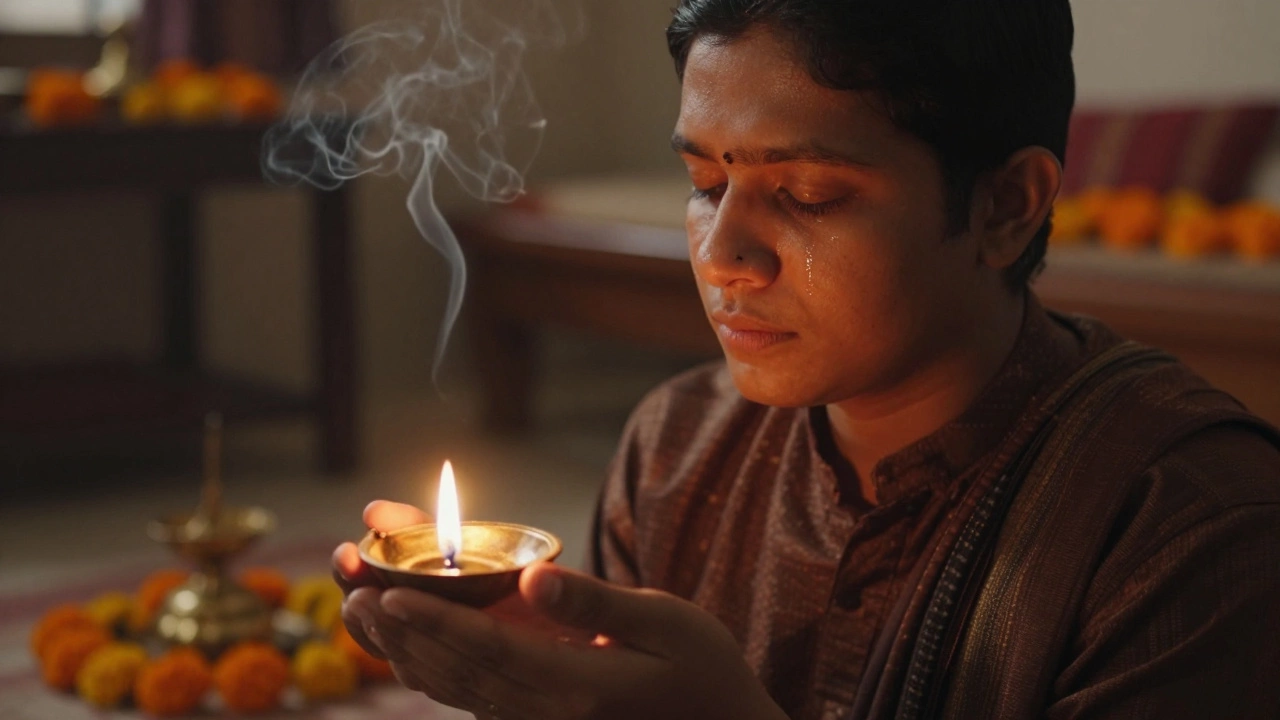
Have you ever sat down for Hinduism a major world religion with ancient roots in the Indian subcontinent, encompassing diverse philosophies, rituals, and practices prayer, closed your eyes, and suddenly found tears streaming down your face? It happens. You aren't alone. In fact, this reaction is so common among devotees that it has its own place in spiritual discussions. It often feels confusing, especially if you aren't thinking about anything sad at that moment. You might be chanting a Mantra a sacred sound, syllable, word, or group of words believed to have psychological and spiritual powers, focusing on a deity, and then boom-tears. It can be overwhelming, leaving you wondering if something is wrong or if this is a sign of something deeper. The truth is, crying during prayer is usually a sign of a profound connection, not a problem to be fixed.
The Spiritual Release of Bhakti
At the heart of this experience is Bhakti Yoga a spiritual path of devotion and love towards a personal form of the Divine. In Hindu tradition, devotion isn't just about following rules; it's about love. When you engage in Prayer the act of communicating with a deity or higher power, often involving praise, gratitude, or requests with genuine intent, you are opening your heart. This emotional opening can trigger a release of stored feelings. Think of it like a dam breaking. You might carry stress, anxiety, or unexpressed emotions throughout your week. When you sit in a sacred space, your defenses drop. The tears are simply your soul exhaling.
Many saints and seekers describe this as a moment of surrender. In English, we say "letting go," but in the context of Spirituality the quality of being concerned with the human spirit or soul as opposed to material or worldly things, it is often called samarpan. It is the act of offering your ego to the Divine. When the ego loosens its grip, the emotions that were suppressed by daily life rush to the surface. This is why crying often happens during specific parts of a prayer, like when you are asking for forgiveness or expressing deep gratitude. It is a physical manifestation of spiritual relief.
Stories from Indian Mythology
If you look at Indian Mythology a collection of traditional stories, legends, and beliefs from ancient India that explain the nature of the universe and human existence, you will find that tears are a recurring theme in devotion. The stories aren't just tales for children; they are blueprints for spiritual experiences. One of the most famous examples is the story of Gajendra Moksha. Gajendra was an elephant king who was trapped by a crocodile. He cried out to Lord Vishnu for help. His tears were not just of fear, but of pure surrender. When the Lord appeared, Gajendra's tears washed away his past karma. This story teaches that tears in prayer are a form of purification.
Another powerful example is Hanuman. When Hanuman recited the Ramayana to Valmiki or when he searched for Sita, his devotion was so intense that it often moved him to tears. In the Ramayana, there is a moment where Hanuman, despite being a mighty warrior, weeps when he sees the suffering of others or when he remembers Lord Rama. This shows that strength and emotion are not opposites in this tradition. True strength includes the vulnerability to feel deeply. When you cry while praying, you are aligning yourself with the energy of these devotees. You are participating in a lineage of emotional honesty that goes back thousands of years.
Consider the story of Prahlada. Even as a child, he was so devoted to Lord Vishnu that he remained calm in the face of death. However, the devotion of his mother, Kayadu, or the reactions of the sages often involved tears of joy or sorrow. These narratives validate the idea that the divine connection is emotional, not just intellectual. You don't just understand God; you feel Him. The tears are the bridge between the mind and the heart.
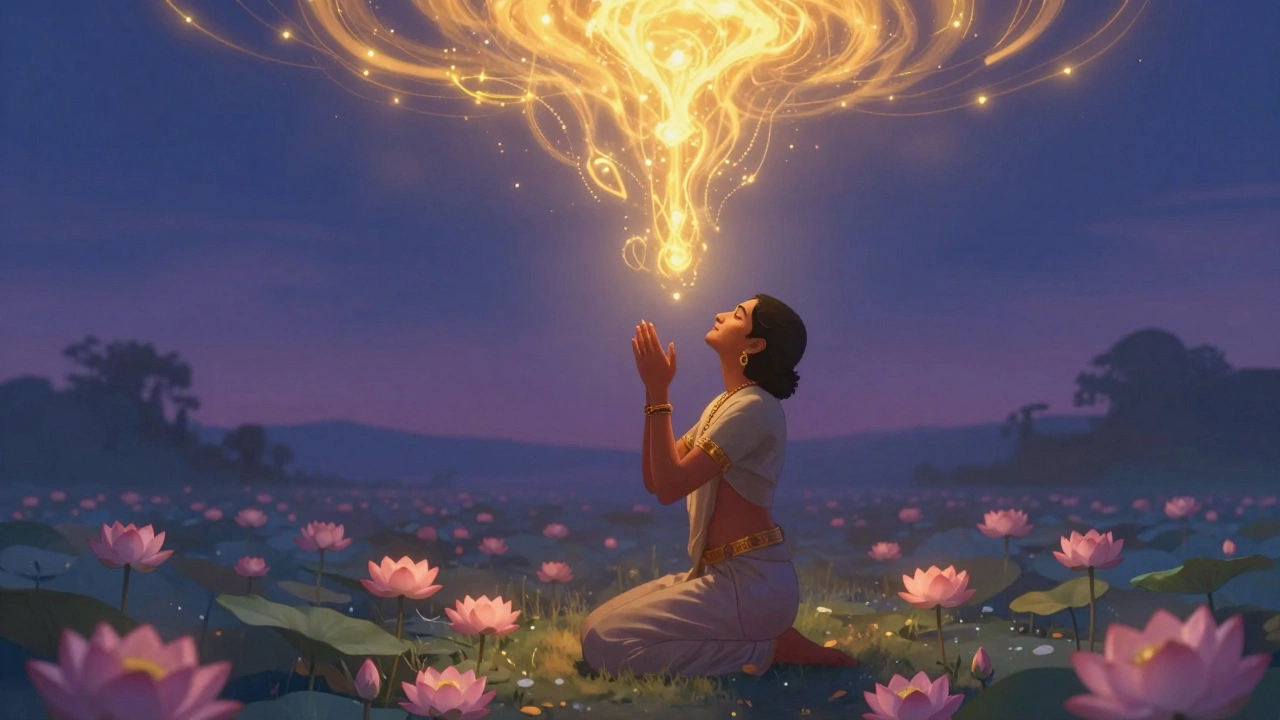
Psychological and Physiological Factors
While the spiritual explanation is profound, there is also a scientific side to this. When you pray or meditate, your nervous system shifts. You move from a state of "fight or flight" (sympathetic nervous system) to "rest and digest" (parasympathetic nervous system). This shift allows your body to process emotions that were held back during the day. Crying is a natural stress relief mechanism. It releases oxytocin and endorphins, which are natural painkillers and mood elevators.
Furthermore, the act of chanting or repeating mantras affects your brain waves. It can induce a state of relaxation where the subconscious mind becomes more accessible. Sometimes, you might cry because a memory surfaces that you weren't aware of. It could be a past loss, a moment of regret, or a feeling of loneliness that you haven't addressed. The prayer creates a safe container for these memories to surface and be released. This is why you might feel lighter immediately after crying during prayer. You have physically expelled the emotional toxins.
It is also worth noting the role of Meditation a practice where an individual uses a technique to train attention and awareness, and achieve a mentally clear and emotionally calm state. Even if you aren't formally meditating, prayer is a form of focused attention. Deep focus often leads to deep feeling. If you are praying in a quiet room, the silence amplifies your internal state. Without the distraction of social media, work, or noise, your true feelings come to the forefront. This is not a flaw in your practice; it is a feature of it.
Understanding the Different Types of Tears
Not all tears are the same. In the spiritual context, it helps to distinguish between them. There are tears of sorrow, tears of joy, and tears of surrender. Tears of sorrow might come from realizing your own imperfections or the suffering in the world. Tears of joy, often called ananda, come from feeling the presence of the Divine. These are the tears that leave you smiling even as you cry. Tears of surrender are the most common during prayer. They signify that you are letting go of control. You are admitting that you need help, and that admission is liberating.
Understanding the type of tears can help you navigate the experience. If you feel heavy or depressed after crying, it might be emotional cleansing from past trauma. If you feel light and energized, it is likely a spiritual connection. Both are valid. The goal isn't to stop the tears but to understand what they are telling you. Sometimes, the tears are a message from your subconscious that you are holding onto something too tightly. The prayer session becomes a therapy session where the Divine is the therapist.

What to Do When It Happens
So, what should you do when the tears start? The most common mistake is to stop praying or to feel embarrassed. You might wipe them away quickly and try to "focus harder." This creates tension. Instead, allow it. If you are sitting, stay seated. If you are standing, stand tall. Let the tears flow without judgment. You can even incorporate the crying into your prayer. Ask the Divine to help you release whatever is coming out. Say, "Please help me let this go." This turns the crying into part of the ritual.
After the tears subside, take a moment to drink some water. Crying dehydrates you slightly, and you want to stay grounded. Then, continue with your practice. You might find that your prayer becomes deeper and more personal after the release. Don't rush to finish just because you got emotional. The emotional peak is often the most valuable part of the session. It is where the real transformation happens. If you feel too overwhelmed, you can pause, breathe deeply, and then resume. There is no rule that says you must sit perfectly still without emotion.
Here is a simple checklist for handling tears during prayer:
- Do not stop chanting or praying immediately.
- Do not judge yourself for being emotional.
- Allow the tears to flow naturally without wiping them away too quickly.
- Use the moment to deepen your surrender.
- Drink water afterward to rehydrate and ground yourself.
- Reflect on what emotion surfaced during the crying.
Connecting with the Divine Through Emotion
Ultimately, crying while praying is a sign of a living faith. A dry, robotic prayer is less effective than one filled with raw emotion. The deities in Indian Mythology are often depicted as parents or friends. You would cry to your parent if you were hurting, right? You would cry to your friend if you were overwhelmed. The same applies to the Divine. The tears are a language. They communicate what words sometimes cannot. They show that you care deeply. This intensity of care is what fuels spiritual growth.
Many spiritual teachers encourage this emotional openness. They say that the heart is the seat of the soul. If the heart is locked, the soul cannot shine. Crying unlocks the heart. It breaks down the walls of the ego that keep you separate from the Divine. When you cry, you are vulnerable, and vulnerability is where connection begins. It is a reminder that you are human, and that humanity is a gift. Do not hide it. Embrace it as part of your journey.
In the end, whether you are praying in Toronto, Mumbai, or anywhere else, the human experience is the same. We all seek connection. We all seek peace. The tears are just the proof that you are trying. They are the evidence that your prayer is real. So the next time you find yourself crying while praying, don't be afraid. Smile through it. It means you are exactly where you need to be.
Is crying during prayer a sign of weakness?
No, crying during prayer is not a sign of weakness. In spiritual traditions, it is often seen as a sign of strength and vulnerability. It indicates that you are opening your heart and releasing suppressed emotions, which is a healthy and necessary part of spiritual growth.
Why do I cry when I chant mantras?
Chanting mantras can induce a deep state of relaxation and focus, allowing subconscious emotions to surface. The vibrations of the sound may resonate with your body and mind, triggering a release of stored stress or emotional energy in the form of tears.
Should I stop praying if I start crying?
It is generally recommended not to stop. Allowing the tears to flow is part of the process. You can continue chanting or praying while crying, using the moment to deepen your surrender and connection with the Divine.
Is there a mythological story about crying in prayer?
Yes, the story of Gajendra Moksha is a classic example. The elephant king Gajendra cried out to Lord Vishnu in surrender while trapped by a crocodile. His tears represented his complete dependence on the Divine, which led to his liberation.
Can crying during prayer be a medical issue?
In most cases, it is a normal emotional or spiritual response. However, if the crying is accompanied by severe distress, panic, or if it interferes with daily life, it might be helpful to consult a mental health professional to rule out underlying anxiety or depression.