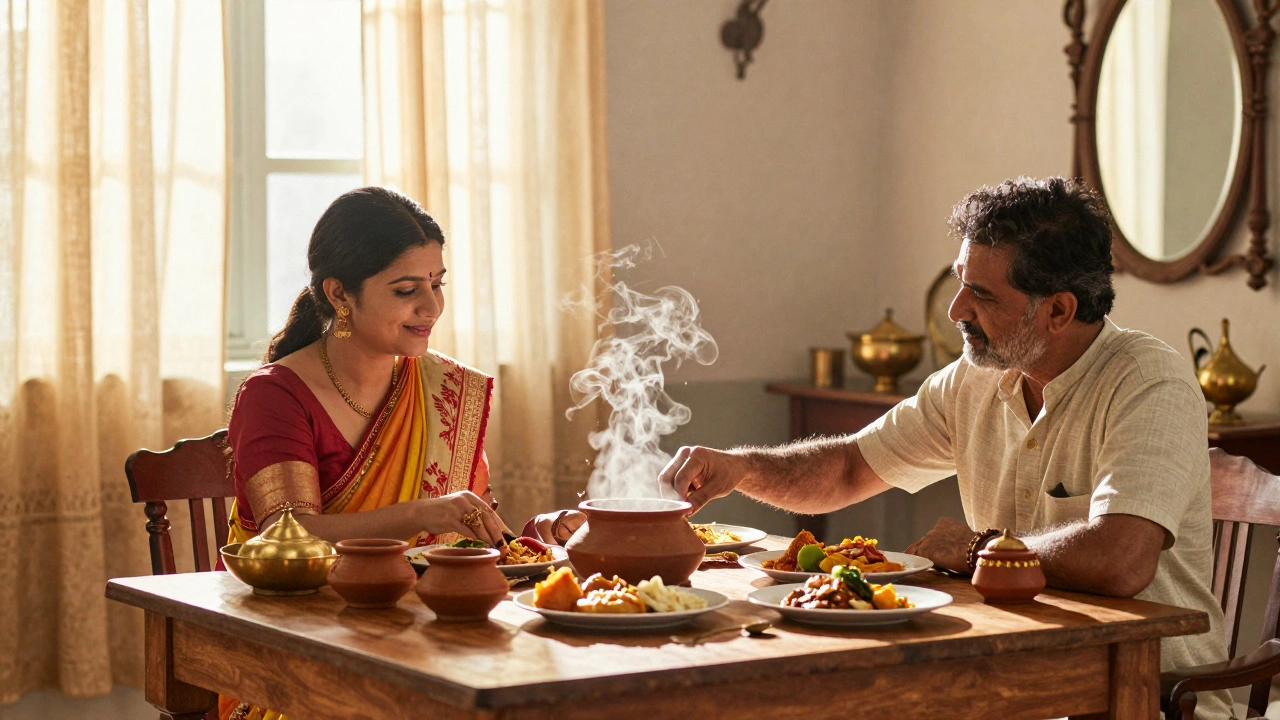
There’s a myth that Hindu wives must follow a strict list of ancient rules-wake up before sunrise, serve food to the husband first, never speak out of turn, wear sindoor every day, and never say no. But here’s the truth: Hindu wife rules aren’t a rigid code handed down from scripture. They’re a mix of regional customs, family habits, and outdated social pressure dressed up as religion.
Where Do These "Rules" Come From?
Many of the so-called rules for Hindu wives trace back to texts like the Manusmriti, written over 2,000 years ago. These weren’t religious commandments-they were social guidelines from a time when women had little legal or economic power. In ancient India, marriage was seen as a woman’s only path to social standing. Her role was tied to her husband’s family, her duty to maintain household harmony, and her identity as a "pativrata"-a devoted wife.
But here’s what most people miss: Hinduism has no single holy book that dictates how a wife must behave. The Vedas, the oldest Hindu texts, never list rules for wives. Instead, they speak of partnership. The Rigveda talks about a bride and groom walking together around the sacred fire as equals. The idea of "saptapadi," the seven steps taken together in a Hindu wedding, symbolizes mutual promises-not one-sided obligations.
What Do Modern Hindu Families Actually Expect?
Today, expectations vary wildly depending on where you live, your education level, your family’s background, and even your husband’s views. In urban India, many couples share chores, finances, and decision-making. In rural areas, traditional roles may still hold strong-but even there, change is happening.
Take the practice of wearing sindoor (vermilion) in the hair parting. It’s often called a "symbol of marriage." But it’s not mandatory. Many educated Hindu women in cities choose not to wear it. Others wear it out of personal choice, not pressure. Same with mangalsutra-the black and gold necklace. Some families insist on it. Others don’t care. The difference? It’s culture, not religion.
Then there’s the idea that a wife must serve food to her husband before eating. In many homes, this is still done out of respect. But in others, meals are shared together. One woman in Pune told me, "My husband eats when he’s hungry. So do I. We don’t wait for each other like it’s a ritual."
The Real "Rules" Are About Respect, Not Control
If you dig into authentic Hindu teachings, the core expectation isn’t obedience-it’s mutual respect. The concept of "dharma" means fulfilling your role with integrity, not submitting to control. For a wife, that means contributing to the household, nurturing relationships, and standing by her family-not being silent or invisible.
Many Hindu texts, including the Mahabharata and the Ramayana, show strong female figures. Draupadi challenged injustice. Sita showed courage under pressure. Parvati was a powerful goddess who chose her own husband. These aren’t passive women. They’re complex, assertive, and deeply respected.
The problem isn’t Hinduism. It’s patriarchy disguised as tradition. Many families use "Hindu rules" to justify controlling behavior. But that’s not what the religion teaches. Hinduism honors the feminine as divine. The goddess Lakshmi is wealth. Saraswati is knowledge. Durga is power. You can’t honor goddesses and treat real women as servants.

What Hindu Wives Actually Do Today
Look around. Hindu wives today are doctors, engineers, entrepreneurs, artists, and activists. They manage households, raise children, run businesses, and lead communities. Many are the primary breadwinners. In fact, a 2023 survey by the Indian Institute of Management found that 42% of urban Hindu households have wives earning more than their husbands.
They still celebrate Diwali with full rituals, cook traditional meals, and wear saris on special days. But they also negotiate mortgages, file taxes, and take parental leave. They argue about politics. They take vacations without their in-laws. They say no to unwanted advice.
One woman in Hyderabad, a software engineer and mother of two, said: "I wear sindoor because I like how it looks. I cook because I enjoy it. I don’t serve my husband first because we eat together. My husband helps with laundry. We split grocery shopping. That’s not against Hinduism. That’s just being human."
What’s Actually Required in a Hindu Marriage?
Legally, under the Hindu Marriage Act of 1955, marriage is a contract between two consenting adults. It doesn’t require any specific behavior from the wife. The only legal "rules" are: both parties must be over 18, not already married, and capable of giving consent.
Religiously, the only non-negotiable part of a Hindu wedding is the seven vows taken around the sacred fire. Each vow is mutual:
- To support each other in health and sickness
- To share prosperity and face hardship together
- To nurture children and family
- To remain faithful
- To honor each other’s families
- To grow spiritually side by side
- To be lifelong companions
Notice anything? No mention of serving food, staying silent, or never leaving the house without permission. Just partnership.

Why This Myth Persists
Why do people still believe in these outdated "rules"? Because they’re easy to repeat. They’re passed down like family stories. A mother-in-law says, "This is how it’s always been." A neighbor says, "Your wife should do this." A TV show shows a submissive wife and calls it "traditional."
But tradition isn’t sacred just because it’s old. Many traditions-like child marriage, dowry, and widow shaming-were once common in Hindu society. We’ve moved past them because we realized they were harmful. The same should apply to rules that treat women as second-class members of the household.
What You Should Really Focus On
If you’re a Hindu wife-or married to one-forget the myths. Focus on these real values:
- Communication: Talk openly about expectations, money, chores, and feelings.
- Respect: Honor each other’s choices, careers, and boundaries.
- Partnership: Share responsibilities, not just roles.
- Autonomy: You have the right to say no, to leave, to grow, to change.
- Love: That’s the only rule that matters.
There’s no Hindu rulebook that says you must be silent. There’s no verse that says you can’t work. There’s no god who demands you wear sindoor every day. What’s sacred is how you treat each other-not what you wear or what you serve.
Modern Hindu marriage isn’t about following old rules. It’s about building something new-something real. Something that lasts because it’s built on trust, not tradition.